Showing posts with label liturgy. Show all posts

Wednesday, April 28, 2010

The Splendour of Worship

People, no doubt, wonder why such fuss is made over extravagant vestments and claim that it's all pomp and circumstance feeding the ego of the ministers. Then there's the usual rant about the poor, how the excessive show of triumphalism is contrary to the heart of Jesus who loved the poor and dispossessed.


This is all true, that Jesus has particular care of the poor and the dispossesed. But really, it is all of us who are poor and dispossessed. We are poor because without God, we are nothing, we have nothing. We do not bring ourselves into existence and neither can we exist without God, however much atheists protest and try to prove this point. We become less human when God is pushed out of the picture. So, yes, all of us are poor. Jesus' Incarnation, His emptying Himself of glory to take on our human nature teaches us this very point. For our sakes, He became poor. We are the poor.

And we are dispossessed. Our sin deprived us of our heritage, that of beholding God face to face. And it is only through Christ that we are able, by adoption through Him in his Passion, Death, and Resurrection, that we are restored to that heritage, that we are sons and daughters of the Most High.

What does this have to do with worship, and vestments, and "pomp".

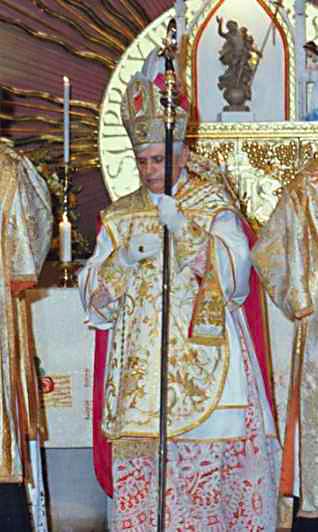
The Pontifical Solemn High Mass last Saturday reminded me once more that God is utterly Other. However much I want to bring Him down to my level, yet He is God, truly adorable and worthy of all the best that I can offer Him through worship. The vestments, the rituals, the gestures bear within them the symbol that God is beyond me. And yet, through the Sacrifice of the Mass, I am drawn into the heart of the Divine.

What was so stunning about the cappa magna that Bishop Slattery was dressed in as he entered the temple, evoked Isaiah: "In the year that King Ozias died, I saw the Lord sitting upon a throne, high and elevated; and His train filled the temple."

Isaiah was given this vision of the splendour and the glory of God.And now, through Christ's Passion, Death, Resurrection, and Ascension, we--foolish and weak that we are, unfaithful and forever wandering away--can know, can glimpse, can be pierced, too, by the glory of God. It is splendid. It is glorious. It is not like us. And we fall down to our faces and say, "Woe is me for I am a man of unclean lips, and I dwell among a people of unclean lips and I have seen with my eyes the King, the Lord of Hosts."

And just like the priest prays before the declaration of the Gospel, "Munda cor meum ac labia mea,omnipotens Dei..." Cleanse my heart and lips. We are once more drawn into that temple where we come to face Truth, Holy, Transcendent, Merciful and Glorious.

Unlike the modern manifestations of the liturgy which pull our attention away from God to fall upon ourselves and our actions and our relevance, this most solemn of rites makes us lift our eyes heavenward, the destiny of our journey. Not by anything that we do, but only through the Offering of Christ in Himself. For our part, it is the offering we give of our heart, our prayer, our whole attention that are required of us. It isn't whether we verbally say things out loud: words are meaningless if we do not have recollection, remembering who we are and who God is, that is, pardon the pun, at the heart of worship.

The infernal and maddening battles over liturgy and whether modern man can rightly understand the words of worship detract from what it is that is being done, who it is that is acting at Mass. We are spectators, you and I, in this grand drama of salvation. It is Mystery that our minds can hardly penetrate. This leaves little room for silly dancing, hand-holding, comedic actions that have nothing to do with the sacred actions happening at Mass. It is Mystery and we are left in awe.

I can understand why liturgical wars are so intense. It is a matter of who is at the heart of the Mass. We feel useless when we aren't "doing anything". Why is it only the priest that gets to do things? Aren't we, all of us, priests in that royal priesthood of believers?

But it is Christ who is the Priest, the only one who can offer a worthy offering to God the Father. And so when the cappa magna passes by, when that sacred minister, with his face set in a solemn way, passes by and his shimmering long train follows, our hearts are lifted because, here, in this person, in this temple, in this hour, Christ enters. This is our Catholic Faith. Through sensible signs, the Divine enters. How blessed are we to witness it and at the end, when we are dismissed, it is our turn to walk in this world bearing this light, this Divine Truth, God is in His temple, let the earth worship.

Source: Argent by the Tiber

Tuesday, March 23, 2010

Holy Week Schedule

Second Sunday of Passiontide (Palm Sunday)
Rosary/Confession at 5:30 p.m.
Sung Mass at 6:00 p.m.
Blessing and distribution of palms before Mass

Wednesday in Holy Week (Spy Wednesday)
Rosary/Confession at 6:30 p.m.
Low Mass at 7:00 p.m.

Holy Thursday
Rosary/Confession at 6:30 p.m.
Mass of the Lord's Supper at 7:00 p.m.
followed by Transfer of the Blessed Sacrament and Stripping of Altar
and Adoration till midnight.

Good Friday
Rosary/Confession at 2.00 p.m.
Stations of the Cross at 2.30 p.m.
Good Friday Liturgy at 3:00 p.m.

Holy Saturday
Rosary/Confession at 10.30 p.m.
The Great Vigil of the Resurrection at 11:00 p.m.

Sunday of the Resurrection (Easter Sunday)
Rosary/Confession at 9:00 a.m.
Sung Mass at 9.30 a.m.

Tuesday, September 08, 2009

Pope Benedict Asks For Greater Composure in the Liturgy

From the NLM:

Last Sunday, the Holy Father visited the Italian cities of Viterbo with its papal palace, where the first papal conclave was held, and Bagnoregio, birthplace of St Bonaventure, about whom Pope Benedict wrote his habilitation treatise (which is being published these days, for the first time in its original version, as the second volume of his opera omnia). In Viterbo, he celebrated Mass in the Faul Valley, immediately below the walls of the papal palace. According to several reports in the Italian press (cf. here, here or here), at lunch that day with the local bishops, the Holy Father made some interesting remarks about the attitude of the faithful attending that Mass. While they are not new or surprising, they certainly bear highlighting. According to the reports, Benedict XVI explained to the bishops present that "he desires a greater composure in the liturgies, in which, he finds, applause and acclamations are out of place." In that sense he commended Sunday's celebration, because the more than ten thousand faithful attending "were very devout and composed." In this, the faithful also followed an invitation made through the speakers installed for the occasion "not to applaud and to remain recollected."

Wednesday, April 29, 2009

Sacred Triduum photos

As promised here are the photos from the Sacred Triduum this year. Click on the photos for the bigger image.

Maundy Thursday


Good Friday


Easter Vigil


Monday, April 27, 2009

Sacred Triduum videos

Here are some videos captured during the ceremonies of Holy Week and the Sacred Triduum.

Washing of feet during Maundy Thursday.

Stripping of altar with the psalm Diviserunt on Maundy Thursday.

Gloria and ringing of bells during the Paschal Vigil Liturgy.

Consecration during the Paschal Vigil Liturgy.

Sorry, but I couldn't get any videos for the Solemn Good Friday Liturgy. More pictures coming soon.

Sunday, April 06, 2008

On Reverent Celebration

Many people, too, concerned about these issues, will ask: Isn't it still possible to celebrate the new liturgy of Pope Paul VI worthily and reverently?. Naturally it is possible, but the very fact that "it is possible" is the weightiest argument against the new liturgy. It has been said that a monarchy's death knell sounds once it becomes necessary for a monarch to be competent: this is because the monarch, in the old sense, is legitimated by his birth, not his talent. This observation is even truer in the liturgy: liturgy's death knell is sounded once it requires a holy and good priest to perform it. The faithful must never regard the liturgy as something that the priest does by his own efforts. It is not something that happens by good fortune or as the result of a personal charism or merit. While the liturgy is going on, time is suspended: liturgical time is different from the time that elapses outside the church's walls. It is Golgotha time, the time of the hapax, the unique and sole Sacrifice; it is a time that contains all times and none. How can a man be made to see that he is leaving the present time behind if the space he enters is totally dominated by the presence of one particular individual? How wise the old liturgy was when it prescribed that the congregation should not see the priest's face - his distractedness or coldness or (even more importantly) his devotion and emotion.

- Martin Mosebach, The Heresy of Formlessness, Ignatius Press 2003

h/t to Daniel Mitsui

Sunday, March 30, 2008

Liturgy, Seafood, and Thirty-One Flavors

By Kurt Poterack

Recently, a friend of mine came to Mass one Sunday at the collegiate chapel where I am themusic director. He normally goes to the parish church. Afterwards he commented, “My, you do a lot of Gregorian chant! Is that really necessary? Isn’t that too much!?” I felt like saying, “If you go to a seafood restaurant would you complain to the manager that there is too much fish on the menu?” I didn’t say this for three reasons: (1) it was one of those great comeback lines that one thinks of only hours later, (2) as a true friend I preferred an explanation to a comeback, and (3) while it makes sense to me and most of the readers of this journal, it probably would have absolutely confused him. Instead I said, “I’m being obedient to Vatican II, article 116 of the Liturgy Constitution”—to which he replied, “Really, I don’t know too much about such things. I suppose I have a lot to learn.”

Now this person is not a liberal Catholic by any stretch of the imagination. He is quite orthodox in matters of doctrine, faith, and morals—and quite devout—but simply does not have much of a liturgical culture. My entrée with him was an argument from the Church’s magisterium. (We were interrupted, but I intend to continue the conversation at some point in the future.)

I know of a number of good Catholics like this. Someone similar said to me a while back, “High Mass, low Mass, charismatic Mass, Latin Mass, how can someone say that one Mass is better than another?” Again, I said, “Oh, but the church herself says that the sung High Mass is the more noble form of worship, Article 113 of Vatican II’s Liturgy Constitution.” I then proceeded to explain that, though a low Mass celebrated on the hood of a jeep by a military chaplain in time of war is objectively the same as a Pontifical High Mass celebrated in St. John Lateran, there is a reason why the church has many times practiced (and recommends) the latter, while the former is only practiced in emergency situations.

What I am finding, in this era of the New Liturgical Movement, is that the liturgical culture of most Catholics has been absolutely decimated—and I am talking about good practicing Catholics. What such Catholics have been left with is a kind of a neo-Thomistic focus on the validity of the consecration and then, lacking a liturgical culture, they fill the void with an American consumerist mentality—a kind of a Baskin-Robbins’ 31 flavors mentality. In other words, “I like Chocolate, he likes Vanilla, she likes Butter Scotch Rum, as long as we eat the same validly made ice cream, it doesn’t matter. There is no normative flavor.” It is totally a matter of subjective, individual choice.

One cannot appeal to such Catholics, at least initially, using aesthetic arguments or even cultural arguments—because there is no normative liturgical culture which they know. They do, however, respond to arguments from authority.

The thing is, though, that there is this objective liturgical cultus that has been the Roman Rite for centuries. Gregorian chant is the music that is normative, proper to the Roman Rite. It is the only music in the official liturgical books for this reason. The Church has continuously taught this throughout the twentieth and twenty-first centuries. Any other music is there by means of addition or substitution for the normative, official music—Gregorian chant.

This is not to deny that these valid “substitutions” can happen to varying degrees based upon pastoral prudence and even subjective choice. The problem is that these subjective choices have been allowed and practiced to such a great degree over the past forty years that the Roman Rite’s very own music has been almost totally erased in the actual experience of probably a majority of Catholics.

The Roman Rite as an actual historical cultus with its own traditions, customs and music has been considerably dimmed. At least before Vatican II Catholics knew “what the score was” even if many of them would go to a more stripped down low Mass because it was quicker.

If I could continue with my restaurant analogy, too many Roman Rite Catholics have been going to seafood restaurants that have been serving little to no fish. They need to learn that, whatever their subjective preferences, fish will be a big part of the menu.

Kurt Poterack is editor-at-large of Sacred Music. He teaches music at Christendom College. poterack@hotmail.com

Source: Winter 2007 Volume 134, Number 4 Sacred Music

Friday, November 02, 2007

Top Ten Unknown Truths About Sacred Music

Here's an interesting and helpful article by Jeffrey Tucker found at the NLM blog:

In the last week, I've spoken before two groups of Catholics about sacred music and taken questions and observed on their faces looks of confusion and enlightenment (I leave aside the case of the heckler who exhibited red-faced anger). From this experience, I again learned the lesson that I somehow never fully grasp: it is not possible to underestimate people's level of knowledge of the basic facts of liturgy and music.

For decades, Catholic music publishers have been cranking out liturgy workbooks, hymnbooks, guidebooks, book books, and sending well-meaning but woefully uneducated workshop leaders to thousands of parishes, while well-heeled organizations have held hundreds of lucrative national conferences designed to somehow get Catholic musicians up to speed.

Incredibly, the results of all this "education" – which has had no unified theme and has been more about marketing expensive, copyrighted music than actually doing what the Church asks – has been to scramble the brains of Catholic musicians around the country to the point that most have not the slightest clue what they are seeking to do. Lots of money has changed hands but we are further away from understanding than ever before.

So here is my list of the top ten musical unknowns of our day:


      The music of the Mass is not of our choosing; it is not a matter of taste; it is not a glossy layer on top of a liturgy. Liturgical music is embedded within the structure of the liturgy itself: theologically, melodically, and historically.

      Hymns are not part of the structure of Mass. Nothing in the Mass says: it is now time to sing a hymn of your choice. Hymns are permitted as replacements for what should be sung but only with reservations.

      The sung parts of the Mass can be divided into three parts: the ordinary chants (which are stable from week to week), the proper chants (which change according the day), and the priests parts that include sung dialogues with the people.

      The music of for the Mass is found in three books: the Kyriale (for the people), the Graduale (for the schola), and the Missale (for the priest).

      To advocate Gregorian chant is not merely to favor Latin hymns over English ones, because chant hymns make up only a small portion of chant repertoire. It is to favor a sung Mass over a spoken one, and to favor the music of the Mass itself against substitutes.

      Cognitive pedagogy is not the primary purpose of music, so, no, it is not important that all people gathered always and immediately "understand the words."

      The music of Mass does not require an organist, pianist, guitar player, bongos, or microphones. It requires only the human voice, which is the primary liturgical instrument.

      The Second Vatican Council was the first ecumenical council to decisively declare that chant has primacy of place: "Ecclesia cantum gregorianum agnoscit ut liturgiae romanae proprium: qui ideo in actionibus liturgicis, ceteris paribus, principem locum obtineat." (And ceteris paribus does not mean: unless you don't like it. It means even if chant cannot be sung because of poor skills or lack of resources, or whatever, it still remains an ideal.)

      There is no contradiction between chant and participation. Vatican II hoped to see that vernacular hymnody would decrease and the sung Mass would increase. Full, conscience, active participation in the Mass means: it is up to the people to do their part to sing the parts of the Mass that belong to the people.

      The first piece of papal legislation concerning music appeared in 95AD, by Pope St. Clement. It forbid profane music in liturgy and emphasized that Church is the place for holy music. All successive legislation has been a variation on that theme.


It's going to take more than one-hour lectures to undo all the misinformation that has been spread for decades, and the publishers of these popular liturgy guides need an education more than anyone else. But let's be clear what we are talking about here. The paradigm of sacred music amounts to a complete overhaul of what most Catholic musicians think belongs in Mass. And the first step to education is to have an educable spirit.

Will musicians and publishers that have been working for decades in a spurious paradigm—the billions involved do not confer liturgical legitimacy—be willing to rethink matters?

Thursday, May 03, 2007

Steubenville

Liturgical and music anarchy are still very much alive and well, even amidst all the talk about "reform of the reform", new ICEL translation, Sacramentum Caritatis, Redemptionis Sacramentum, Motu Proprio, et cetera, et cetera, et cetera. Behold the Holy Week liturgy at neo-con charismatic heaven Franciscan University of Steubenville (FUS), where popular Novus Ordo celebrity Scott Hahn currently lectures at. And oh dear, the Wikipedia entry for Scott Hahn even calls FUS "a major center of conservative Catholic thought in the United States"! I shudder to think what they would consider as liberal centers of Catholic thought.

http://www.youtube.com/watch?v=naH8r3b7zAg

Compare this to another scenario also in the United States. No prizes for guessing, but which would you consider as a better candidate to be "a major center of conservative Catholic thought in the United States"? :)

http://www.youtube.com/watch?v=OQogMEXeKig

P.S. Sorry for not embedding the video here as embedding has been disabled by the video owner.

Friday, March 02, 2007

Preparation for Holy Week liturgy

As it is only a few weeks away from Holy Week, I wish to highlight a very, very useful resource that most start-up scholas would highly appreciate. Thanks to the effort of the Church Music Association of America, the Officium Majoris Hebdomadae, et Octavae Paschae, Cum Cantu has been made available both in free electronic PDF form as well as printed form (at a very nominal price). As the title implies, it contains the entire sung liturgy in Holy Week right up to the Octave of Pascha (yes, even the sung Passion narrative! :)..... A little note though to those who may not be aware. This version is from 1923, so it would be wise to match the appropriate chants to the Holy Week liturgy used in your parish (e.g. Pius XII revision). Check with your priest to be sure.

As far as I am aware, this work will complement the Ordo Hebdomadae Sanctae (OHS), which is the liturgical book used on the altar during Holy Week instead of the Missale Romanum, especially as it includes the Passion narrative neumes, which most OHS editions did not include.