Showing posts with label latin. Show all posts
Showing posts with label latin. Show all posts
Tuesday, March 02, 2010

Friday, February 19, 2010
Vatican Confirms Freedom of Priests to Celebrate TLM
Vatican confirms freedom of priests to celebrate Extraordinary Form whenever they like – no need for 'stable group'
Damian Thompson
Link to Original
Good news from Rome: the Vatican has further underlined the freedom of priests to celebrate Mass in the Extraordinary Form whenever they choose. Two important points have been clarified by Ecclesia Dei, which will make it more difficult for the English, Welsh and above all Scottish bishops to stall the implementation of Summorum Pontificum:
1. A priest does NOT have to be approached by a “stable group” of the faithful in order to schedule a PUBLIC celebration of the Extraordinary Form – he may choose to do so, for example, in order to introduce his parishioners to this ancient form of the Roman Rite. Or because it’s his aunt’s birthday. Any reason, really.
2. A Mass in the Extraordinary Form may replace a regularly scheduled Mass in the Ordinary Form.
You can find more details of the Ecclesia Dei ruling here, on the excellent New Liturgical Movement blog. I do hope that priests will be encouraged by this document to exercise their full rights under Summorum Pontificum. I know of several instances in which British bishops are trying to undermine the Pope’s wishes, though I’m not going to go public where it would make the situation worse. But it is common knowledge that the situation is particularly serious is Scotland, where EF Masses are extremely rare and official claims that there is no demand for them need to be scrutinised very carefully, shall we say. More on that later.
Meanwhile, traditionalist priests and seminarians should take heart. Your hour is coming.
Monday, April 27, 2009
Sacred Triduum videos
Here are some videos captured during the ceremonies of Holy Week and the Sacred Triduum.
Washing of feet during Maundy Thursday.
Stripping of altar with the psalm Diviserunt on Maundy Thursday.
Gloria and ringing of bells during the Paschal Vigil Liturgy.
Consecration during the Paschal Vigil Liturgy.
Sorry, but I couldn't get any videos for the Solemn Good Friday Liturgy. More pictures coming soon.
Saturday, February 07, 2009
Another disobedient Asian prelate
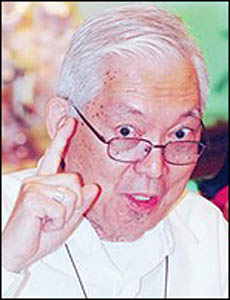 The Archdiocese of Manila has just released the most restrictive application of Summorum Pontificum that I have ever seen. I really cannot understand the implacable opposition of Cardinal Rosales to the Missal of 1962.
http://www.rcam.org/Homilies/
ARCHDIOCESAN GUIDELINES ON THE CELEBRATION OF THE MASS ACCORDING TO THE RITE OF THE ROMAN MISSAL PUBLISHED IN 1962 (TRIDENTINE MASS)
In accordance with the norms laid down by the Apostolic Letter, issued motu propio, of His Holiness, Pope Benedict XVI, Summorum Pontificum, We hereby establish the following guidelines and conditions on the celebration of the Mass according to the rite of the Roman Missal published in 1962 (Tridentine Mass) in the Archdiocese of Manila:
The regulation of the celebration of this extraordinary form of the Mass belongs to the Archbishop of Manila, through the Minister of the Ministry for Liturgical Affairs of the Archdiocese of Manila.
This form of Mass is to be celebrated only at the Christ the King Chapel of the Metropolitan Cathedral of Manila once a month, but not on Sundays and Solemnities.
The presider at this form of celebration should be a priest duly appointed by the Archbishop of Manila.
To ensure the solemnity and orderliness of the celebration of this form of Mass, the participation of other ministers (i.e., lectors, Master of Ceremonies, servers, choir, etc.) in the liturgy is to be determined and regulated by the Ministry for Liturgical Affairs of the Archdiocese of Manila.
The celebration of the extraordinary form of the Mass in this Chapel is open to any individual or group in the Archdiocese of Manila who may have the desire to participate in such celebrations. Further requests from individuals or groups from the parishes of or who belong to the Archdiocese of Manila to celebrate this form of Mass is to be directed to join the monthly celebration at the Manila Cathedral.
It is highly encouraged that a missal / booklet of the rite in Latin and English be prepared to help the faithful follow the celebration. It is like wise encouraged that those who will participate in this Mass undergo a catechetical orientation before the celebration.
The Archbishop of Manila has jurisdiction over this celebration and, therefore, can decide to limit or discontinue this monthly celebration anytime he judges that this is not consonance with the whole pastoral direction of the Local Church.
Given in Manila, this 8th day of December 2008.
+GAUDENCIO B. CARDINAL ROSALES
Archbishop of Manila
Friday, October 31, 2008
Pius XII reciting Pater Noster
This is THE right (some will read that as Roman!) way of Latin pronunciation.
Friday, August 08, 2008
Motets during a Requiem Mass
Something useful from a Q&A forum:
The Bach-Gounod is less offensive, though still "operatic."
There is some confusion about that.
The new one is on the Musica Sacra website: http://www.musicasacra.com/communio/
The Clementine Vulgate Communion Psalms are at:
Index of /Verse Book Images
Main Readme
Index Communionem A-O
Index Communionem P-V
In general, the fullest possible version of the LITURGICAL texts (either Chant or classical sacred polyphony) should be sung BEFORE one considers ADDING anything to the music-list.
Historically, most motets were settings of the antiphons on Magnificat at Vespers, and were sung when the antiphon was repeated. That's where Anglican Evensong got its "Anthem after the Third Collect" ... for the most part, there was no provision for adding music to the Mass, except possibly at communion-time, but by Mozart's time, the musical settings of Agnus Dei had become so long that they lasted right through Communion AND the Absolutions.
Q: Can you tell me if the Panis Angelicus and the Ave Maria can be properly sung at a Missa Cantata Requiem Mass during the Offertory and Communion times only? If sung, would this be following the Rubrics according to the allowance now (1962 Missal)?
A: St. Pius X's motu proprio on church music, "Tra le Sollecitudini" disallows MOST solo-singing (as distinct from the liturgical intoning done by one or more chanters).
That said, it is PERMISSIBLE to sing "Ave Maria" during the Offertory of a Requiem Mass, FOLLOWING the chanting of the proper Offertory text.
However, since the Requiem Offertory, "Domine Iesu Christe" is virtually the ONLY Offertory in the Latin Rite which retains an obligatory Verse, "Hostias et preces," it is likely that there wouldn't be TIME to sing Ave Maria, unless the Offertory is sung to a VERY simple formula, or recto-tono.
The Offertory PROPER should be given pride of place. And the celebrant shouldn't be kept waiting on account of the singing of "Ave Maria."
In passing, most of the Offertory Verses are now available, either in Dom Karl Ott's original "Offertoriale" (out of print), or in Solesmes new printing, "Offertoriale Triplex", which includes the Transalpine rhythmic neums along with the "standard" Gregorian notation. Their use has been permitted since the 1930s, along with Chants Abreges and various other Desclee/Solesmes publications from that period.
Schubert's "Ave Maria" should NOT be used, UNLESS the "corrected" version with the complete Latin text is sung, and even then it is an occasion of scandal ... he wrote it for his mistress, with a non-liturgical German text. The Latin came later.
The Bach-Gounod is less offensive, though still "operatic."
The Franck or the Arcadelt (both found in the St. Gregory Hymnal) are more suitable.
"Pie Iesu" from the Durufle or Faure Requiem would be more appropriate at the Offertory, unless it is sung following the Elevations (which used to be the custom).
There is no particular problem with singing Franck's or Lambillotte's "Panis Angelicus" at Communion-time, particularly if there is a general communion of the faithful, as long as the Communion Antiphon is sung FIRST.
There is some confusion about that.
In the days when general communions were not the rule, singing the Communion after the celebrant's Communion moved it to the Ablutions, PRACTICALLY speaking.
But it is a processional chant to be sung DURING Communion, and books with the Latin psalms to accompany the Antiphons have existed since the 1930s. Both the old and new Vulgate Communion Psalters can be found online.
The new one is on the Musica Sacra website: http://www.musicasacra.com/
The Clementine Vulgate Communion Psalms are at:
Index of /Verse Book Images
Main Readme
Index Communionem A-O
Index Communionem P-V
In general, the fullest possible version of the LITURGICAL texts (either Chant or classical sacred polyphony) should be sung BEFORE one considers ADDING anything to the music-list.
Historically, most motets were settings of the antiphons on Magnificat at Vespers, and were sung when the antiphon was repeated. That's where Anglican Evensong got its "Anthem after the Third Collect" ... for the most part, there was no provision for adding music to the Mass, except possibly at communion-time, but by Mozart's time, the musical settings of Agnus Dei had become so long that they lasted right through Communion AND the Absolutions.
Monday, May 26, 2008
Palestrina, we love you
Here's another attempt at Sicut Cervus, this time as the offertory hymn for Corpus Christi 2008 with Rev. Fr. Couture as celebrant.
Next is Panis Angelicus as the communion hymn of the same feast. Apologies from Tenor 1 as his voice was affected by the aircond and having difficulties of hitting the high notes during pp, thus his use of falsetto. We will be attempting this again on another occasion, Deo volente. This is fast becoming our favourite piece after Sicut Cervus....
Next is Panis Angelicus as the communion hymn of the same feast. Apologies from Tenor 1 as his voice was affected by the aircond and having difficulties of hitting the high notes during pp, thus his use of falsetto. We will be attempting this again on another occasion, Deo volente. This is fast becoming our favourite piece after Sicut Cervus....
Sunday, May 11, 2008
Learn how to pray and sing TLM

I am reproducing here a posting from Argent about this...from St. John Cantius parish website. The Canons Regular have given us Sancta Missa. For $28 you get a lot! Here's the section Epistola-Evangelium
Oratio – Epistola – Evangelium
50. Oratio – Tonus Festivus
51. Flectamus Genua
52. Humiliate Capita Vestra Deo
53. Oratio – Tonus Solemnis
54. Oratio – Tonus Simplex
55. Tonus Prophetiae
56. Punctum Interrogativum
57. Tonus Epistolae
58. Tonus Evangelii – Simplex
59. Tonus Evangelii – Alter Tonus
60. Tonus Evangelii – Solemnis
Tuesday, May 06, 2008
Trailer for the FSSP TLM Instructional Video
This DVD makes an excellent gift to your parish priests to prod them to start celebrating the TLM in the spirit of our Holy Father Benedict XVI's Motu Proprio Summorum Pontificum. You can get it here.
Sunday, February 24, 2008
Lotti's Miserere
This was taken during our rehearsal on 23rd February 2008. Our regular alto voice went AWOL, thus it was only STB.
Wednesday, February 20, 2008
The Protestants weigh in
 Christian Century
21 August 2007
Worshiping with Agatha Christie by Carol Zaleski
WHAT WOULD Agatha Christie Do? In 1971 she put her name on a petition urging the conservation of an endangered species: the traditional Latin mass, threatened with extinction in the aftermath of Vatican II. The petition noted that the preconciliar mass, a thing of beauty in its own right, was the inspiration for countless works of poetry, philosophy, music and other arts throughout the centuries. Intervening, as UNESCO might, to safeguard an intangible cultural treasure, the petition asked the Holy See to consider "the appalling responsibility it would incur in the history of the human spirit were it to refuse to allow the Traditional Mass to survive, even though this survival took place side by side with other liturgical forms."
There were 56 other signatories, among them Nevill Coghill and Colin Hardie of C. S. Lewis's Inklings circle; Maurice Bowra, the Oxford don whose humorous assaults on priggishness are the stuff of legend; Kenneth Clark, the television face of Civilisation; "Liberal Lion" Jo Grimond; abstract sculptor Barbara Hepworth; Welsh modernist poet David Jones; literary critic F. R. Leavis; Whiskey Galore novelist Compton Mackenzie; the 17th Duke of Norfolk; the Earl of Oxford and Asquith; Ralph Richardson; Yehudi Menuhin; Nancy Mitford; Robert Graves; Kathleen Raine; Graham Greene; Iris Murdoch. The list includes cradle Catholics, Catholic converts, Protestants, Anglicans, Jews and nonreligious humanists.
The petition made it to the desk of Pope Paul VI. There is a story, probably apocryphal, that he said, "Ah, Agatha Christie!" and promptly agreed that the 1962 form of the Roman Rite could be used in England and Wales on special occasions. This concession is known informally as the "Agatha Christie Indult." John Paul II extended the privilege, and now Pope Benedict, in his motu proprio of July 7, has seen to it that Agatha Christie's wish can be granted wherever her mysteries are read. The 1962 revision of the Tridentine Mass, published by John XXIII, is to be the "extraordinary form" of the Roman Rite, while the postconciliar mass, usually celebrated in local languages, remains the "ordinary form" of the Roman Rite. On the face of it this would seem to be a liberalization of current practices rather than, as some critics call it, a retraction of Vatican II.
Despite confusion about this in the media, it's not a question of bringing back Latin. The official version of the postconciliar mass is in Latin. When students ask me where they can go to experience a Latin mass, I point them to the thoroughly modern Benedictine monastery down the road, where the postconciliar mass is sung beautifully in Latin Gregorian chant, with the priest facing the people, scriptural readings in English and no ladies looking prim in lace mantillas.
Why, then, all the fuss? It goes back to the contested legacy of the Liturgical Movement, a renewal effort which spread beyond its 19th-century roots in the Benedictine monasteries of Europe and drew Christians of all communions into a search for ways to deepen participation in the sacramental mysteries of Christ. The hallmark of the Liturgical Movement was the recovery of patristic sources. As this movement took on ecumenical proportions, the effect was to raise awareness throughout the Christian world of the beauty and dignity of ordered celebration of the Eucharist, liturgical seasons and canonical hours of common prayer. The pioneers of the Liturgical Movement sought a balance between word and sacrament, immanence and transcendence, private devotion and communal fellowship. They favored organic development, not rupture with the past. The same principles animated the renewal proposed by Vatican II. Unity-in-diversity--not uniformity--was the watchword.
For some who find fault with the recent motu proprio, however, it seems that nothing short of uniformity will satisfy. Those who regard the mass of Paul VI as invalid and those who thoroughly reject the Tridentine Mass are likely to suffer in equal measure the disappointment of realizing that their vision of liturgical correctness will not prevail.
For my part, when I've been to a Tridentine Mass, I've been sensible of a certain awkwardness, as if I might use the wrong spoon, so to speak, or drink out of the finger bowl. But I remember seeing a photograph of the old mass being celebrated on a World War II battlefield. The soldiers kneel behind a priest who himself kneels before a rock-hewn altar covered by a simple cloth. It's not that the priest has turned his back to the people; one sees immediately he is praying in unison with the soldiers, facing east, as his fellow servants serving the crucified Lord on the plain of their peril. There is no privatistic mysticism in wishing to see such usages restored.
Best of all will be the opportunity for growth in both forms of the Roman Rite, by means of their mutual influence. The aspic will be melted off the Tridentine Mass, the fussiness will pass away, as it is celebrated in light of the communion ecclesiology and pastoral warmth of Vatican II. By the same token, the postconciliar mass will gain in solemnity and fidelity to its Latin original, provoking, it may be hoped, a renewed sense of the mystery at the heart of Christian worship. Such developments should be reason enough for all Christians--indeed, for all who care for the poetry, music and drama of the Western religious imagination--to rejoice in diverse tongues. It's a door thrown open, not a clock turned back.
Carol Zaleski is professor of world religions at Smith College.
Sunday, February 17, 2008
Solemn Pontifical Mass by Papal Nuncio in Austria
This was to commemorate the 150th Anniversary of the Apparition of Our Lady at Lourdes.
H/t to the NLM.
H/t to the NLM.
Thursday, January 10, 2008
Sicut Cervus
This was taken during our rehearsal on 10th January 2008. Sorry about the abrupt stop because the camera batteries went out of juice. The beginning part shown in this video was also off but thankfully we managed to do better as we rehearsed over and over again.
Friday, January 04, 2008
Traditional Latin Mass in Kuching, Sarawak
 There will be a Traditional Latin Low Mass to be offered by Rev. Fr. Emerson Salvador, FSSPX in Kuching, Sarawak.
Date: 28th January 2008 (Monday)
Time: 18.00
Venue: 288 Lorong B4A, Tmn BDC, Stampin, 93250, Kuching, Sarawak, Malaysia.
Please contact Ms. Marie Clement at +6 019-8597584 or +6 082-462740 or email globetraveller80@yahoo.com for further details.

Monday, November 19, 2007
Ubi Caritas
This was sung as the communion hymn for the Mass of the 25th Sunday after Pentecost 2007 in conjunction with the administration of the Holy Sacrament of Confirmation by H.E. Bishop Alfonso de Galarreta.
Thursday, October 11, 2007
Support for our local parishes
Sacred Heart Choir is offering support to parishes in our archdiocese as far as finances permit for the implementation of the Holy Father's Motu Proprio Summorum Pontificum. We can help to assist in sourcing for items necessary for the celebration of the Traditional Latin Mass not currently available in most parishes, and help to train servers and choirs. Interested parish priests who would like to learn how to celebrate the Traditional Latin Mass may also get in touch with us for help. We encourage anyone who is interested in having a funeral, baptism or wedding in the Traditional rite to ask their pastor for it in accordance with the provisions of Summorum Pontificum (unofficial English translation here) and to contact us for assistance. See contact information at the sidebar.
Wednesday, October 03, 2007
Te gestientem gaudiis
 Here's a neat little explanation of the offertory hymn that we are going to sing on Sunday Oct 7th, Te Gestientiem Gaudiis.
The author of this hymn is Fr. Augustine Thomas Ricchini (1695-1779). A native of Cremona, Italy, he held several ecclesiastical offices and was a friend of Pope Benedict XIV. Fr. Ricchini first held the office of the Secretary of the Congregation of the Index, and then was the Master of the Sacred Palace. He was also an adviser to the Master General of the Dominicans from 1759 to 1778.
This hymn, along with its three companion hymns, Caelestis aulae Nuntius, In monte olivis consito, and Iam morte, victor, obruta are the hymns from the Roman Breviary for the Feast of the Most Holy Rosary (Oct. 7). The hymns were composed by Fr. Ricchini in 1757 and first appeared in the Dominican Breviary. Later, when the present Office was approved for the Universal Church in 1888 by Pope Leo XIII, these four hymns were added to the Roman Breviary. In the current Liturgia Horarum, the only surviving hymn for the feast is now Te gestientem gaudiis, the other three having been deleted.
The Feast of the Most Holy Rosary itself actually goes back to Pope Saint Pius V, who established this feast on the anniversary of the naval victory won by the Christian fleet at Lepanto over the Turkish fleet on 7 Oct., 1571. The victory is attributed to the intercession of the Mother of God, whose aid was petitioned through the prayers of the Rosary before the battle. The celebration of this feast day is an invitation to all to meditate upon the mysteries of Christ, following the example of the Blessed Virgin Mary, who was so singularly associated with the incarnation, passion, death, and glorious resurrection of her Son, the Son of God.
The subject of all four hymns are the fifteen mysteries of the Rosary. The first three hymns deal with each set of Mysteries: the Joyous, the Sorrowful, and the Glorious. The fourth hymn is a short summary of the first three hymns. This hymn summarizes the themes of the first three hymns, namely the Joyous, Sorrowful and Glorious Mysteries of the Rosary.
| TE gestientem gaudiis, te sauciam doloribus, te iugi amictam gloria, o Virgo Mater, pangimus. | THE gladness of thy Motherhood, the anguish of thy suffering, the glory now that crowns thy brow, O Virgin Mother, we would sing. |
| Ave, redundans gaudio dum concipis, dum visitas; et edis, offers, invenis, Mater beata, Filium. | Hail, blessed Mother, full of joy in thy consent, thy visit too; joy in the birth of Christ on earth, joy in Him lost and found anew. |
| Ave, dolens, et intimo in corde agonem, verbera, spinas crucemque Filii perpessa, princeps martyrum. | Hail, sorrowing in His agony the blows, the thorns that pierced His brow; the heavy wood, the shameful Rood Yea! Queen and chief of Martyrs thou. |
| Ave, in triumphis Filii, in ignibus Paracliti, in regni honore et lumine, Regina fulgens gloria. | Hail, in the triumph of thy Son, the quickening flames of Pentecost; shining a Queen in light serene, when all the world is tempest-tost. |
| Venite, gentes, carpite ex his rosas mysteriis, et pulchri amoris inclitae Matri coronas nectite. | O come, ye nations, roses bring, culled from these mysteries divine, and for the Mother of your King with loving hands your chaplets twine. |
| Iesu, tibi sit gloria, qui natus es de Virgine, cum Patre, et almo Spiritu, in sempiterna saecula. | All honor, laud, and glory be, O Jesu, Virgin-born to Thee; All glory, as is ever meet, To Father and to Paraclete. |
Source: Preces LatinaeLatin text from the Roman Breviary, translation by Abbot Oswald Hunter-Blair, abbot of Fort Augustus Abbey, Scotland (1853-1939).
Monday, October 01, 2007
Conference - The Holy Catholic Mass - What We Have Lost
 Dear Friends in Christ,
In conjunction with the release of the Motu Proprio Summorum Pontificum by our Holy Father Pope Benedict XVI, we are inviting you and your non-muslim friends to a conference as follows:
The Holy Catholic Mass - What We Have Lost by Rev. Fr. Daniel Couture.
The talk will centre on:
- The Tridentine Latin Mass - not just an issue of language but sacramental form and matter.
- How to recover and reclaim what we lost.
- Pope Benedict XVI's recently released Motu Proprio: Summorum Pontificum
Date: October 6, 2007 (Saturday)
Time: 6.00pm
Venue: Perdana Room, Bukit Kiara Equestrian Resort, Jalan Bukit Kiara,
Off Jalan Damansara, Kuala Lumpur
Admission : By Invitation Only (For non-Muslims only)
For more information, please contact :
Mr. Nicholas Lim +60 12 2966347 or
Mr. Cyril Yee +60 16 3619104
Please invite your friends to this interesting and not-to-be-missed
conference! Do RSVP if possible.
Monday, September 10, 2007
Monday, August 27, 2007
Subscribe to:
Posts (Atom)