Showing posts with label anarchy. Show all posts

Friday, February 15, 2013

On veneration of ancestors


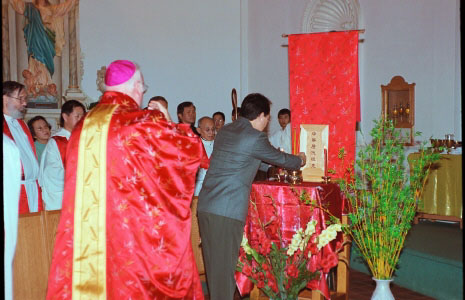
Since it is Chinese New Year again, the topic of ancestral veneration done in certain Novus Ordo churches crops up again and here are some thoughts from yours truly and the response from Rev. Fr. Daniel Couture and Rev. Fr. Francois Lainey on this matter.

This is mostly in response to the articles written by Rev. Fr. Michael Cheah (of the Penang Diocese) part1, part2 and Deacon Sherman Kuek (Melaka-Johor Diocese)

Many Catholics in Malaysia of ethnic Chinese-descent are converts. I do not agree if it is done during Holy Mass. Even Fr. Michael Cheah concedes that it is to be considered as a 'para-liturgy', but you can't force everyone to take part in it if it is a 'para-liturgy'.

As a Chinese, we must also bear in mind the common pagan/superstitious belief that the spirit of the dead ancestor resides in the tablet (http://en.wikipedia.org/wiki/Spirit_tablet) a.k.a. 神主牌 or 神位 (seat of the spirit). See also http://en.wikipedia.org/wiki/Ancestor_veneration_in_China. I would think that the very idea of the dead having power or effect over the living descendants would have been anathema .

I still cannot find a valid reason why is there a need to do it in church, more so since it is also causing scandal among Catholics (Chinese and non-Chinese alike). We can visit the graves to clean it, but I don't see a need to offer joss-sticks, food, tea/wine, paper money, etc.

Some Catholics might not have those pagan/superstitious ideas when they perform the rites, but certainly it can't be said for all Catholics. Thus, I think Deacon Sherman Kuek's article is considered the moderate approach to this controversy.

"In other words, our way of evangelization should not make it more difficult than necessary for people to accept the Gospel. In the days of ancient China, to insist on terminating veneration rites actually scandalized the populace and prevented them from accepting the Gospel.
This cannot be said of most disapora Chinese today. It is reasonable to hold that neither forbidding nor permitting veneration of ancestral tablets would gravely affect the success of the Church’s mission to evangelize the Chinese community in a place like Malaysia.
If anything, non-Christians probably find it strange that Catholics would do such a thing in the course of performing our liturgical rites. It is perhaps wise to ask ourselves if such a practice truly serves its evangelistic purpose or if we do it just because we can."

----------------------------------------------------------------------------------------------------------
Response by Rev. Fr. Daniel Couture:

In all these matters, one has to remember some essential doctrinal issues:
1) At death the soul is separated from the body, is judged, and goes to heaven, purgatory or hell (we speak here of those who have reached the age of reasons “ancestors”)

2) We can only know for sure the state of a deceased soul in the case of a canonisation, when the Church, and only the Catholic Church, tells us that that soul IS in Heaven, and we can pray TO it. For all the other souls, we can only pray FOR them (although the saints do say that we can also pray TO the souls in Purgatory). (I do not enter here in the questionable modern canonisations.)

3) Reincarnation – in another person, an animal or a tablet – is absolutely false, both philosophically and theologically.

4) Souls separated from their body do not eat.

5) We can certainly honor the memory of our ancestors, honor their photo, out of filial piety, but it must have nothing that includes or implies their presence in a thing, their power of intercession, their material needs.
------------------------------------------------------------------------------------------------------------
Response by Rev. Fr. Francois Laisney:

Father Couture has given all good principles on the matter. There is one additional consideration that I would add: to distinguish between natural and supernatural veneration. But first of all, let us explain what is veneration.

To venerate, to honour, means to give a testimony to the excellence of someone, as St Thomas teaches. Now there are four kinds of excellence on earth that is given special honour: 

1) excellence of knowledge: e.g. Nobel prices for scientists, titles (such as university titles: Doctor …), and even prizes in school (e.g. first prize of English, of science, of math, of history…)

2) excellence in virtue: e.g. military medals to reward the courage of some soldiers, even Olympic medals (for bodily virtue…)

3) excellence in authority: presenting arms when a general reviews his army, or titles given to people in authority (your lordship,…). This is given to government authorities, to judges, … 

4) the special excellence of parents, which St Thomas explains is the excellence of being at the ORIGIN of what the children have: they received their life from their parents, and a very great many other things. If we would reckon how much we owe our parents, we would easily understand that we can hardly repay them enough. To honour them is to acknowledge this excellence that THEY have over us. Note that benefactors – in a much lesser way – also participate of that kind of excellence, and honour is due to them for that reason.

Now every one can easily see that in all these four domains, God possesses the supreme excellence:

1) He knows absolutely everything, not only which has existed, exist and will exist, but also all that could have existed if He had so created them… and above all the created things, He knows Himself comprehensively.

2) He possesses the supreme virtue, i.e. goodness in all His actions, His being is pure Act, pure Goodness. Thus He always acts with supreme wisdom, supreme goodness, fortitude, kindness, mercy, etc.

3) God possesses supreme authority, and all authority come from Him (Rom. 13:1)

4) God is at the origin of all created beings, of all good.

And in this matter of excellence, there is an essential difference between God’s excellence, which He possesses by Himself, not having received it from anyone, and any creature’s excellence, which is only relative: it always came ultimately from God, Who is the First Cause of all good and therefore of all excellence. God alone can be the FIRST in any of the above domains. He also is the source of life; parents only transmit life; He alone is the source of goodness; anyone else can only transmit goodness… 

Therefore there is due to God a unique veneration, called Worship. It is a very grave sin to worship anyone else than God.

So now we come to my point. There are two levels of excellence: natural excellence and supernatural excellence. All the examples above were of natural excellence. But God also offers to men a supernatural excellence: sanctifying grace, a participation in the divine life. Not all men accept it and live it. It is received at baptism, is lost by mortal sin, is recovered by penance, grows through the Sacraments and prayer and the practice of good works, etc.

One can find also supernatural excellences of the four kinds expressed above:

1) the Doctors of the Church had an excellent knowledge of Revelation, of the Doctrine of Christ, and they receive for that reason a special honour: the title of Doctor of the Church. 

2) Saints excelled in supernatural virtue, and receive the veneration of “dulia”. 

3) those in authority in the Church: Pope, bishops, priests receive for that reason special honours. 

4) Those priests and others who have given us the supernatural life in Baptism, the supreme Food in the Holy Eucharist, and many other supernatural benefits ought also to be honoured for that reason too.

Now the business of the Church is above all to give worship to God and in a lesser degree to give that supernatural honour to those who deserve it, i.e. to the Saints. It is also the business of the Church to pray for our departed relatives.

It is NOT the business of the Church to give NATURAL veneration to those who – even truly – deserve it: the Church does not confer Nobel prizes, Olympic medals, etc. Hence it seems to me that it is not befitting to have in the church the veneration of ancestors – which, when done without superstition, is perfectly legitimate, acknowledging all the good natural things one has received from them, as explained above. That natural veneration may well be done at home, when it is without superstition.

In order to clearly distinguish between the natural veneration of ancestors and the supernatural worship to God and (lesser) honour to the Saints, it is particularly important not to mix things up: venerating the ancestors in the church brings the danger to forget that essential difference. Thus it is not only out of place, it is also dangerously misleading.

It should be noted that when Pius XII permitted the veneration of ancestors, it was NOT in the churches, but only as a natural honour as explained above. To bring it into the churches is the wrong inculturation of Vatican II. It seems to me that this settles the matter. What do you think?

Monday, August 15, 2011

"Atmosphere of holiness"

From: A time of sharing at Sikh centre
TheCatholicNews - AUGUST 14, 2011, Vol 61, No 16

“I felt the atmosphere of holiness when entering the sanctuary,” commented Ms Clara Nai, a parishioner of the Church of the Immaculate Heart of Mary.

---------------------------------------------------------------------------------------------------
[Ed: That's what the Novus Ordo religion is about. Feelings. Imagine if everything is based on feelings, I could say something similar when I enter St. Mary of the Angels Church in Singapore, pic here. I would say I could feel the atmosphere of emptiness or void. Neither does the grotesque-looking figure of "Christ" suspended in mid-air helps one to pray either.]

Wednesday, July 27, 2011

Eucharistic "Danny Boy" Prayer

From the blog of Fr. Z:
-----------------------------------------------------

From a reader:

That is strange.

Last weekend we had a visiting priest and something strange happened.
He sang the first part of the Eucharistic prayer to the tune of “Danny Boy”. Well, needless to say most of us were a little more than thrown off by this priest’s crooning. He had a good voice but it was so strange. After mass it was explained to several of us that chanting is acceptable and this was just another musical version of the prayer, like the chant. Can a priest set the prayers of mass to whatever tune it suits him?

Weird. And wrong.

Singing the Eucharistic Prayer to the tune of “Danny Boy” is reason #24456 for why we needed Summorum Pontificum.

And would I be right in assuming that this was a Mass “facing the people”? And that the priest was….not particularly young?

While there are approved liturgical books with musical notation for the Eucharistic Prayer, there is no one approved way to sing it. Sadly, some priests and bishops have made up their own versions. Results vary. Priests are wise to stick to approved books, in my humble opinion, or at the very least stick closely to the model of sacred chants of our tradition.

Music for Mass is not a mere ornament, external to the liturgical action. We cannot simply change it arbitrarily. It is of the essence of the liturgical action, and integrating part of the liturgical action. Music for Mass must be artistic and sacred. The texts which are set should be sacred texts proper for liturgical worship. The music should be art and in an idiom which is recognizable as sacred. That is a tricky issue, of course. Allow me to illustrate by simplification.

“Danny Boy” has a nice, sentimental tune, but there is nothing of the sacred about it. When you hear Danny Boy, you think of Irish pubs. And the more pints you have, the better you are at singing it, alone or with others. When you hear a Sousa March you think of a parade or sporting event. You don’t, however, go to a parade or football stadium and expect to hear Gregorian chant… unless of course that parade is a liturgical procession. You don’t want Sousa in church or chant at the ball game.

“Danny Boy” doesn’t belong at Mass. No matter how well the priest could sing it, the tune of Danny Boy has the wrong idiom for Mass.

I have often wondered if, in the case of priests who make up their own idiosyncratic thing, they are not making Mass about themselves. “Look at me! Listen to how clever I am!”

It seems to me that, as younger men come up in the ranks, men who are open also to our older, traditional Form of Holy Mass, this sort of thing will quickly fade.

Priests have to get themselves out of the way of the liturgical action, of what the Lord – the true Priest at Mass – is doing.

In Sacramentum caritatis 23 we read that:

… priests should be conscious of the fact that in their ministry they must never put themselves or their personal opinions in first place, but Jesus Christ. Any attempt to make themselves the centre of the liturgical action contradicts their very identity as priests. The priest is above all a servant of others, and he must continually work at being a sign pointing to Christ, a docile instrument in the Lord’s hands. This is seen particularly in his humility in leading the liturgical assembly, in obedience to the rite, uniting himself to it in mind and heart, and avoiding anything that might give the impression of an inordinate emphasis on his own personality.

Friday, April 15, 2011

"ecclesiastical karaoke"

H/t to WDTPRS:

From CNA:

London, England, Apr 14, 2011 / 05:46 am (CNA).- A Grammy winning music director has delivered a stinging attack upon modern Church music. Joseph Cullen, choral director at the London Symphony Orchestra, says that since the 1960s there has been a “glaring lack of sympathy” for “worthy sacred music.”

Writing in the April 9 edition of the English weekly The Tablet, [?!?] he praised the music used during last year’s papal visit to the United Kingdom. But he added: “Sadly such excellence is untypical of the vast majority of our Catholic churches. There is a glaring lack of sympathy for the heritage which should be the bedrock of worthy sacred music in today’s Church.”

[...]

He writes, “Low-quality material in both inspiration and facility is commonplace. Hymns are set to popular music (for example, “My God Loves Me” to the tune of “Plaisir d’amour”) with little regard to the inappropriateness of the original and well-known words.”

He also criticized the practice of a lone cantor leading the singing in parishes. “The misuse of one booming voice behind a microphone, an ecclesiastical karaoke, seems to have killed off unified congregational singing.”

[...]

Sunday, October 17, 2010

Chupungco: Veneration of relics is "a sad chapter in the history of the liturgy"

From Rorate Caeli, we read about the absurd writings of Anscar Chupungco who denigrates veneration of relics (even authentic relics) as "a sad chapter in the history of the liturgy"!

Now, read what the Council of Trent says about this matter in its 25th Session:

The holy Synod enjoins on all bishops, and others who sustain the office and charge of teaching, that, agreeably to the usage of the Catholic and Apostolic Church, received from the primitive times of the Christian religion, and agreeably to the consent of the holy Fathers, and to the decrees of sacred Councils, they especially instruct the faithful diligently concerning the intercession and invocation of saints; the honour (paid) to relics; and the legitimate use of images: teaching them, that the saints, who reign together with Christ, offer up their own prayers to God for men; that it is good and useful suppliantly to invoke them, and to have recourse to their prayers, aid, (and) help for obtaining benefits from God, through His Son, Jesus Christ our Lord, who is our alone Redeemer and Saviour; but that they think impiously, who deny that the saints, who enjoy eternal happiness in heaven, are to be invocated; or who assert either that they do not pray for men; or, that the invocation of them to pray for each of us even in particular, is idolatry; or, that it is repugnant to the word of God; and is opposed to the honour of the one mediator of God and men, Christ Jesus; or, that it is foolish to supplicate, vocally, or mentally, those who reign in heaven. Also, that the holy bodies of holy martyrs, and of others now living with Christ,-which bodies were the living members of Christ, and the temple of the Holy Ghost, and which are by Him to be raised unto eternal life, and to be glorified,--are to be venerated by the faithful; through which (bodies) many benefits are bestowed by God on men; so that they who affirm that veneration and honour are not due to the relics of saints; or, that these, and other sacred monuments, are uselessly honoured by the faithful; and that the places dedicated to the memories of the saints are in vain visited with the view of obtaining their aid; are wholly to be condemned, as the Church has already long since condemned, and now also condemns them.

Friday, October 08, 2010

GIA's so called Gloria...urrgh....

Listen to this and what does it remind you of?
.
.
.
.
.
As for yours truly, it sounds like the ending of some TV series...or an extremely long TV/radio commercial jingle. What do you think?

Saturday, March 27, 2010

Swaying pots of smoke

What's with the Novus Ordo fetish with swaying pots of smoke by middle-aged people? Just trying to get them something to do so that they feel important? How about improving the singing and music first? If the Vatican can do nothing concrete against these nonsense, any Catholic worth his name should have nothing to do with the Novus Ordo, even for the so-called "reform of the Reform".


h/t to Rorate Caeli for this alert.

Tuesday, March 23, 2010

Is the Teaching of the Encyclical Humanae Vitae Taught and Practiced in the Church?

From Totus Tuus:

Fr. John A. Nariai (成相明人) of Humanae Vitae Research Institute (フマネ・ヴィテ 硏究會) in Japan gave a great speech at the Love, Life and Family Conference hosted in Daegu, Korea in 1998. The respectable Japanese father reported a quite deplorable reality of Catholic Church on the issue of contraception. His criticism on Catholic Church in Japan was also translated into Korean language.

Is the Teaching of the Encyclical Humanae Vitae Taught and Practiced in the Church? ?

"Now, Japan is not counted as one of the dissenting nations, however, in the statement of Japan Bishop's Conference of 1968, there is one too many "if." Listen carefully to the statement which I quote now: "If somebody, notwithstanding his good will to fulfill the directives of the encyclical Humanae Vitae, is unable to observe it in some matters because of objective and necessary circumstances, he should never think himself separated from the love of God...Rather we advise them to deepen their trust in God, and to participate fervently in the works of the Church and to receive the sacraments." Unquote. The words are open to a catastrophic interpretation of the worst kind. They could mean that those who think they must contracept are invited by the bishops to receive the Sacraments―confession and Holy Communion―without making a firm purpose of amendment. Are the bishops of Japan not seducing its people to sin? It looks like it. And that seems to be the practice for many in Japan. Martin Luther once gave this blasphemous advice; "Pecca fortiter, et confide fortius" (Sin bravely and trust even more strongly.) Regrettably our bishops in Japan acted like Luther. Japan's Catholic population is not growing at all. It is around 430 thousand since many years ago, and the seminaries are empty if I may exaggerate. Something drastic needs to be done. How can the Church in Japan expect God to give more baptisms and priestly vocations, while she is not fully faithful to the teachings of Humanae Vitae? She is only partially Catholic, if not heretic."

I cannot say that the situation of Church in Korea has been better than that of the Church in Japan. Although Catholic Bishops conference in Korea (CBCK) has occasionally made statements objecting abortion, the teaching of Humanae Vitae has been widely neglected and silenced. Actually, abortion and contraception has been very uncomfortable teachings for the most clergy in Korea and most Korean pastors let lays decide following whatever their own conscience tells them is right.

As a result of the pastoral neglect, Korean Catholics recorded almost the same rate of abortion as that of general population in Korea. According to Fr. Stephen Jae-Bong Jang's article that appeared on weekly bulletin of Pusan Archdiocese on May 27, 2007, 66% of Korean Catholic women have had abortions.

"Contraception facilitates the kind of relationships and even the kind of attitudes and moral characters that are likely to lead to abortion." - Professor Janet E. Smith, The Connection between Contraception and Abortion.

Monday, March 22, 2010

In Novus Ordo land, they don't even want to kneel to God anymore

From Fr. Z's blog with his emphases and comments:

Ottawa archbishop lays down law on kneeling
Tuesday, April 7, 2009
By Jennifer Green

OTTAWA — Ottawa’s archbishop has ordered all Catholics to conform in how they kneel during mass, despite widespread grumbling that uniformity doesn’t equal sanctity, or even unity. [Note the vocabularly choices. The writer doesn’t seem to like this.]

Archbishop Terrence Prendergast circulated a letter recently asking that everyone kneel for the entire Eucharistic prayer from "Holy, holy, holy" to the conclusion "Let us proclaim the mystery of faith"—about five minutes in all.

Currently, some congregations stand for most of the prayer, kneeling only as the priest prepares holy communion. Some stand for the whole thing; others kneel throughout.

Archbishop Prendergast said in his letter: "I have noted a wide range of practices … which present a lack of harmony in a matter where we should be united—the worship of God.

"I know that it may not be easy for some to accept. However, I am convinced its implementation will bring blessings to our archdiocese and I invite your co-operation with this directive." [Notice how we have moved from "order" to "ask" to "invite".]

In an interview later, he explained: "It’s a sign of reverence. People say, ‘I don’t like that. We are the people set free, we no longer have to kneel to God,’ and I said, ‘Wait a minute, we do have to kneel to God. Christ knelt in the garden. People knelt before Jesus. Why can’t we do that for a few minutes at mass?’ "

One woman told him her husband might not come to church because of this. [How stupid is that?] "She said, ‘we French Canadians have a bit of an inferiority complex. We don’t like people telling us what to do’." [Imagine.]

He replied that, if the husband does come, he is free to stand through the prayer, but at the back of the church, where he won’t confuse everyone else. [For heaven’s sake.]

It seems a small thing to ask the faithful to kneel [to GOD] during mass, but opponents say that’s just the point, especially since it is the archbishop’s first firm order since he arrived in this area last year.

[Now get this stunningly obtuse comment….] "Is that all they have to think about?" asked former Ottawa councillor Toddy Kehoe, a parishioner at St. Joseph’s parish on Laurier Avenue East. "I don’t see the Catholic church as doing loving things. I don’t see them as the caring community they should be. It isn’t whether you stand or kneel."

St. Joseph’s Rev. Richard Kelly declined to comment, [?!?] as did a staff member who said in an e-mail: "It is hard to believe that a kneeler is such a big topic, and I wish I could say something about this piece of furniture that was meaningful, [So do I. You ought to be able to.] and about the prayer posture we have been requested to assume, but we are in difficult times and the focus for us as a parish is really how can we participate in the truth and reconciliation process with the aboriginal community of Canada." [Connect this to the stunningly obtuse comment, above.]

Even Rev. William Burke, associate director of the national liturgy office at the Canadian Conference of Catholic Bishops, refused to comment for fear of fanning the controversy. [?!?] Canadian bishops have already agreed to adopt this rule when the new missal, or Catholic mass book, is introduced in the near future.

Archbishop Prendergast acknowledged the underlying strains. "Every time you talk about liturgy, everything else going on in the church is reflected." [YES! He get’s it. Save The Liturgy – Save The World, too.]

Right now, the Catholic church is asking, "Is (the mass) our thing or is it God’s thing? There are certain tensions in the church about that.

"After 40 years since the Vatican Council, we have gotten away from certain aspects of reverence; we’re trying to have more harmony and co-ordination. Harmony will help bolster a sense of divine worship, something that has slipped away.

"What has happened with the liturgy is that it is being asked to bear too many things." [That is interesting.]

At one mass, people got so enthusiastic about greeting each other at the exchange of the peace that it took 45 minutes to get back to the pews and resume the service. [!]

"That’s not what mass is about. It’s about worshipping God," Archbishop Prendergast said.

"At one time, nobody ever applauded. Now, they applaud for everything. It becomes more like a concert." [grrrr]

As to his authoritarian message, he said, "The bishop is the mentor of the liturgy, moderator, the one who calls the shots. I try to do it gently."

Nevertheless, to both clergy and congregants, he says, "I know you disagree, but I would like you to come along."

If someone comes to church and stubbornly stands, they won’t be asked to leave. But, the archbishop says, "You sort of wonder, what are they proving when there are two people standing in a church of 500 kneeling? Some people always have to let you know they’re right."

Monday, March 08, 2010

From WDTPRS: Priest constantly ad libs

From Fr. Z of WDTPRS:

From a reader. You can make your own comments.

I have just returned from Mass. As usual, during the Mass I was constantly distracted by the consistent ad libbing by the priest celebrant. Permit me to offer a sample:

Before the Sign of the Cross: Father reads a snippet from a "liturgical cheat sheet" that introduces the "theme" of the Mass.

Introduction to the Penitential Rite: Father gives a introductory monologue that gives the weather report and welcomes our visitors, who we are always happy to have with us. He then calls us to recall "the times when we have been too much to ourselves and loved each other less."

The Prayers of the Faithful: After the banal intercessions from the "liturgical cheat sheet," Father improvises prayers for the suffering in Haiti, announcing how much money was collected and thanking the parishioners for their generosity; for those serving in the military—living and deceased—their "parents, grandparents, aunts, uncles, and surrogates" (I’m NOT making this up); and on and on and on. The Prayers of the Faithful went on for 5 minutes! I realize that, in the great scheme of things, 5 minutes doesn’t seem long, but it is an eternity at Mass.

The "Orate Fratres": "Let us pray that this our sacrifice and all that we do will become acceptable to God the Almighty Father."

The "Mysterium Fidei": "In song, let us proclaim this great mystery of our faith."

The "Per ipsum et cum ipso": "For it is through Him, and with Him and in Him…."

The Invitation to the Our Father: "Let us with faith and love, in union with God our Father and as one family, we proclaim that prayer which Jesus taught us."

The "Ecce Agnus Dei": This is Jesus Christ, our hope and our peace, the Lamb of God who takes away the sins of the world. How happy and blessed are we to be called to supper."

This said, my question is this: after over 35 years of priesthood and over 35 years of "doing his own thing" at Mass, will he, all of a sudden with the new translations, actually start to "say the black and do the red"? Will bishops and those entrusted with implementing the new translations, actually INSIST that priests not do what this man has been doing Sunday after Sunday for years and years since his first Mass? And who is going to hold them accountable? Bishops? The laity? In fairness to the bishops, bishops can’t be everywhere. As to the laity, priests often resent, no matter how tactfully, respectfully, and charitably states, any constructive criticism about the way a priest celebrates Mass.

My great fear is that, despite the new translations, priests will continue to do whatever they wish with their parts in the Mass simply because no one is going to hold them accountable for otherwise.

Thanks for listening

Monday, February 15, 2010

Kuala Lumpur parishes will only give Communion in the hand!

Here's a letter from the Archbishop of Kuala Lumpur posted in parishes of the archdiocese:

To all the Catholic Faithful

H1N1 INFLUENZA VIRUS

Greetings of Peace and Joy,

The media has been updating us on the growing threat of the H1N1 influenza pandemic in the world and most especially the increasing number of deaths in our country.

I wish to exhort each of you to take special care of your health and be extra cautious when in places with large gatherings.

As a precaution, the following will be observed in our Churches:
* Communion will only be given in your hand
* Holy water will not be placed in the fonts
* Avoid shaking hands during the sign of peace

Please continue to pray for God's blessing of good health for all.

God bless you.

----------------------------------
I have several questions for His Lordship:
1) Wouldn't a better precaution would be to advise those with flu-like symptoms to stay at home instead?
2) How would the execrable practice of Communion in the hand be a good precaution against the virus when there will also be contact with the faithful's hands? This also seems to contradict the third precaution listed above. We might as well suspend giving Holy Communion temporarily until the situation improves. Or is it because receiving Holy Communion at every Mass is a mandatum of Novus Ordo mass goers?

Saturday, April 18, 2009

Singing Satan's Parts?

Interesting article from Boniface on some new developments in Novus Ordo land. Disturbing, to say the least.

Tuesday, November 04, 2008

What shall we name this?

From somewhere closer to home, we have some Filipino inmates asked (or forced?) to perform some kind of dance with a thousand arms, during a mass by Cardinal Vidal. Look at this video that I stumbled upon accidentally:

and the first thing that came to my mind was this:

Know why "Rock Masses" are such pathetic lame ideas when teenagers know they are better off going elsewhere for rock music? I guess the lesson here is.. if Catholics wants to imitate something, they'd better do a darn good job at imitating, else forget it because it will look like a cheap imitation at first sight.

Friday, June 06, 2008

A sad day

Below is an article from Radio Vaticana regarding the recent ad limina visit of the bishops/archbishops of Malaysia to the Holy Father. Such is the sad state of affairs in the current hierarchy here in Malaysia. Oremus.

Pope learns of diversity of Malaysian Church

(02 June 08 - RV) Bishops from the South East Asian Nation of Malaysia begun their Ad Limina pilgrimage to Rome Monday.

There are around 800,000 Catholics in Malaysia - approximately 3% of the total population. The country is divided into nine dioceses including three archdioceses, Kuala Lumpur, Kuching and Kota Kinabalu. We spoke to the Archbishop of Kuala Lumpur MURPHY PAKIAM about his meeting with the Holy Father:


"The Church in Malaysia is diverse, it has four races, four languages four cultures. The Holy Father was happy to hear that we are forming them into a community of God's people and bringing them to well beyond their racial, linguistic, cultural barriers to form one community of God's people. Then he was surprised and happy to know that our priests have to speak at least three languages to preach the World of God to the people. He understands very well when I said that we have no time to teach them Latin and that this great move that is in Europe to bring Latin back does not work for people in the small young Church in Malaysia. He was surprised to hear of missionaries coming as far as Malaysia in the attempts to bring the Tridentine rite here. He was happy to learn also that we are moving a lot with inter-religious dialogue, more than dialogue of coming together of religious leaders because we are Hindus, Sheiks, Buddhists Muslims and so forth and he was happy that I had gone for a trip to China and that there was more than just talk of building relationships of friendships among the different religious leaders, because it is a good way of proceeding to put into action the Churches teaching in Nostra Aetate".
------------------------
Comment from the source who sent this: "The transformation of the Catholic Church in Malaysia into some sort of Malaysian Catholic Church. How insular. Aiya, make friends with everyone else but alienate other Catholics. Pls la... too many languages? Unite them all with Latin la... Sometimes I wonder what they are thinking and what the nuncio is thinking, creating an insular, under-trained priesthood. When the Pope speaks, they always think 'Hey, this is all and good, but it does not apply here.'. What rubbish. If the Catholic Church chooses to open a branch, I'll join. The Malaysian Catholic Church, like the Chinese Catholic Church (Communist) can go to hell."

On another note, have a look at the video below which was highlighted by Fr. Tim Finnigan with the title "Multicultural Youth Mass at Lourdes" by......surprise, surprise....the SSPX.

Read Fr. Finnigan's account about his experience here. I wonder, if the young French children at Lourdes have no problems with Latin, why does our archbishop here thinks that Asian children, youth and adults would have problems with it?

Saturday, May 31, 2008

World Youth Day: Catholicism or Corruption?

OK, if most of you don't already know what World Youth Day is all about, watch this video. Is this the kind of thing the youths of our parishes are asking sponsorship to attend? What would Our Lord ask us on the Last Day on how we spend our money up to the last farthing?

Friday, May 23, 2008

Mark of the Beast Theater

From the infamous St. Joan of Arc parish in Minneapolis, this is their so-called Palm Sunday celebration. No prizes for guessing that they believe they originate from animals, with the spirits of the animals watching over them....


Updated: The video owner has disabled embedding, but you can still view it here.

Monday, May 19, 2008

A party of old fogeys gone cuckoo


I think Simon Cowell (of American Idol fame) would say: "You can't sing, you can't dance, so stop wasting our time and get the hell out of here!"