CMAA has again provided an invaluable free resource for the start-up scholas by providing an online downloadable edition of Fr. Carlo Rossini's Propers of the Mass for the Entire Ecclesiastical Year - Set to Gregorian Psalm Tones with Organ Accompaniment. Download it here. Our choir started singing some of the more complicated tracts and graduals in Lent by referring to this book. It was only slowly and after much more practice did we sing everything according to the Graduale Romanum.
See a short write-up about this book from an earlier blog entry from February which also shows where to get the printed version here.
Showing posts with label books. Show all posts
Showing posts with label books. Show all posts
Thursday, October 25, 2007

Saturday, September 15, 2007
The Little Office of the BVM with Chant
 Description from Baronius Press:
This is the first ever edition that includes the complete Gregorian Chant for the Little Office – in traditional four stave notation! The music for the Little Office has never before been gathered together in one volume. For many people the Gregorian chant of the Little Office offers an introduction to the beauty of the Church’s traditional liturgical heritage. This volume will help you sing all the Hours of the Little Office.
Our edition includes a commentary on the rubrics and ceremonial by “A Master of Novices” (which was first published in the early twentieth century), and also includes a description of the indulgences with which the recitation of the Little Office has been enriched by Holy Mother Church.
The Little Office of the Blessed Virgin Mary is a shorter form of the Divine Office in honour of the Blessed Virgin Mary. It has long been the Church’s daily liturgical prayer to Our Lady, and these hours of praise have been used by Priests, religious and the laity throughout the centuries. Lay people used to flock to the great Cathedrals to publicly recite The Little Office during the Middle Ages, and during the great persecution, when the practice of the Catholic Faith was illegal in Great Britain, Bishop Challoner commended The Little Office to his flock.
Through its psalms, antiphons, readings, responsorials, and prayers the Little Office stresses the role Our Lady played in salvation history, and how through her fiat the divine Word took flesh in her womb and achieved salvation for us all; and how Our Lord granted her the first fruits of the general resurrection in her holy and glorious assumption.
All Catholics are called to a consistent prayer life. For those who do not feel called to recite the Divine Office, but still wish to participate in the liturgical prayer of the Church, or for those who have a particular devotion to the holy Mother of God, there is no finer form of prayer than the Little Office of the Blessed Virgin Mary.
Buy it here.Wednesday, July 18, 2007
Liber Usualis (1961)
 Hear ye! Hear ye! The ubiquitous chant book for the Traditional Roman Rite, the Liber Usualis (1961 edition) is now available for free download online from the good folks at CMAA.
No more excuses of expensive Libers from Novus Ordo parishes wanting to implement Pope Benedict XVI's motu proprio Summorum Pontificum.
Thursday, March 15, 2007
Kyriale Romanum (1961)
Gregorian chant has long transmitted the mystery and majesty of the Catholic liturgical tradition. Newly republished, the Kyriale Romanum of 1961, preserves between its covers an invaluable patrimony of ancient and medieval chants for the Ordinary of the Mass. It collects from the Graduale the most frequently-used chant settings throughout the liturgical year, with eighteen mass settings, six credos, and numerous settings for feasts and holy days, including the solemn procession on the feast of Corpus Christi. As Catholics are becoming increasingly aware of and interested in their liturgical heritage, this beautiful and affordably-priced volume is of great value to choir directors, choristers, and laypeople who wish to participate fully in the venerable liturgical tradition of the Roman Rite.
Available in both hardcover (US$28) and softcover (US$18) editions, the hardcover edition is excellent for long term use in choirs, scholas, and as a supplement to the parish hymnal which more often than not contains only the common mass settings (i.e. I, II, VIII, IX, XI, XVII, or worse......only VIII)
Updated: There is a free downloadable PDF edition available here as well (courtesy of Una Voce Germany and CMAA).
Updated again: Another Kyriale available in free downloadable PDF edition here which is an extract of the 1961 Graduale with navigation links and Solesmes-style rhythmic markings.
Thursday, March 08, 2007
Gregorian chant textbook
Gregorian Chant according to the Solesmes Method (1930) by Dom Gregory Sunol, O.S.B. is now available as a free PDF download or paperback print version for only US$22. Great for beginners as well as a good reference textbook for the pros. Yes, yes, I have heard snickering remarks about the Solesmes method being "outdated", "erroneous scholarship", etc. However, with no less an authority than St. Pius X himself sanctioning the Solesmes method, I think I'm in safe hands.
Next would be the Graduale Romanum (1961) which would suffice to replace the Liber Usualis for most scholas as it contains all the chants proper to the 1962 Roman Missal. Unless your schola needs to sing the Divine Office as well, this would be more than adequate as it also contains the chants for Vespers. It also contains Pope Pius XII's reforms for Holy Week. Comparing the price between a new Liber Usualis (more than US$100) and the printed Graduale Romanum (US$60), I don't think I need to say more as to which is the obvious choice if I'm on a tight budget. The free PDF edition has long been made available and CMAA is now offering the print edition in two paperback volumes (US$30 for Vol I, US$30 for Vol II).
Friday, March 02, 2007
Preparation for Holy Week liturgy
As far as I am aware, this work will complement the Ordo Hebdomadae Sanctae (OHS), which is the liturgical book used on the altar during Holy Week instead of the Missale Romanum, especially as it includes the Passion narrative neumes, which most OHS editions did not include.
Friday, February 16, 2007
Some other useful books for a choir
I'm wish to highlight a couple of books today. Other than the hymnals (which I will review in an upcoming post) and a Liber Usualis or the Graduale Romanum (not the new edition used in the New Mass!), several other books can be considered helpful. Anyway, yours truly doesn't even own a Liber Usualis himself as a new copy costs more than US$100 a piece (gulp!) but we have some donated copies from the Singapore priory and neume from free online sources.
First on my mind would be the well-known Fr. Carlo Rossini's "Proper Of The Mass" whic h are propers set to Gregorian psalm-tones with organ accompaniment. Beautiful, yet simple enough for most congregations to start a choir in order to sing the propers, if going full-scale Gregorian melodies seems intimidating at first. Republished by Neumann Press, this indispensable book is readily available in either hardcover or spiral-bound. In fact, our choir use pieces from this book especially for overtly long Gregorian melody pieces, such as the Tract for the First Sunday of Lent
. Singing that piece alone in the original Gregorian melody actually takes about 12'30"!!! I guess that's why it's used to start Lent.... a penitentially long piece. (grin)

Next, I was alerted to a book published by Roman Catholic Books. The title is "Papal Legislation on Sacred Music". Though I have yet to get my hands on this book, it seems like a complete and authoritative compilation of papal and SCR (Sacred Congregation of Rites) decrees on sacred music, going all the way back to the time of Pope St. Damasus. I guess it would be useful for those involved in Church music to refer to this every now and then, to remind ourselves on the duties and responsibilities as well as what's permitted and what's not permitted in the Sacred Liturgy. Now, anyone willing to sponsor this as a gift for us? (wide grin)
First on my mind would be the well-known Fr. Carlo Rossini's "Proper Of The Mass" whic
Thursday, February 08, 2007
What's the difference between the Liber Usualis and the Graduale Romanum?
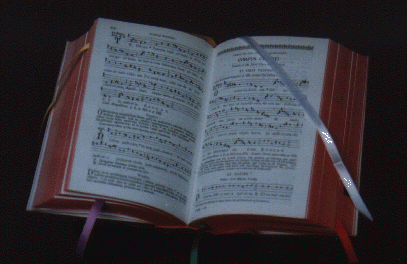 This question has plagued yours truly for some time and Deo gratias, this resource came just in time to the rescue. See the List of Uniform Titles for Liturgical Works of the Latin Rites of the Catholic Church.
This list gives a comprehensive listing of pre and post-conciliar liturgical books in the Latin rite, including the rites of the religious orders and other such variants.
Thanks to NLM for the info.
Subscribe to:
Posts (Atom)