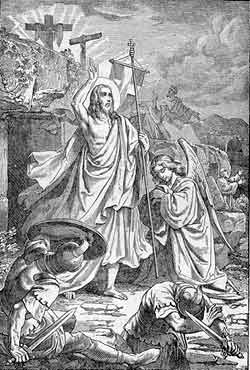
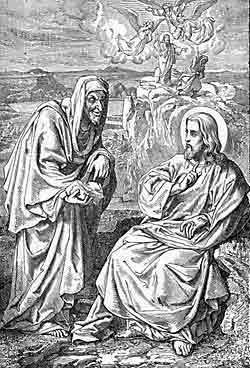
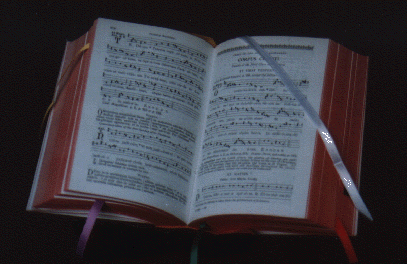
- Procession: Jesus Christ Is Risen Today (SBH#044)
- Vidi aquam
- Introit: Resurrexi
- Kyrie I
- Gloria I
- Gradual: Haec dies
- Alleluia: Pascha nostrum
- Sequence: Victimae paschali laudes
- Credo IV
- Offertory: Terra tremuit
- Offertory hymn: Regina Caeli, Jubila
- Sanctus I
- Agnus Dei I
- Communion hymn: O Filii Et Filiae
- Communion: Pascha nostrum
- Recession: The Strife Is O'er
Attached to the Chapel of the Sacred Heart of Jesus (SSPX Malaysia) under the guidance of the priests of the Society of Saint Pius X. Most Sacred Heart of Jesus, have mercy on us!
Saturday, March 31, 2007
Resurrection of Our Lord & Saviour Jesus Christ (the Solemnity of Solemnities)
Paschal Vigil
- Canticle: Cantemus Domino
- Canticle: Vinea facta est
- Canticle: Attende caelum
- Litany of the Saints (until "Omnes Sancti et Sanctae Dei, intercedite pro nobis")
- Canticle: Sicut cervus
- Litany of the Saints (cont. from "Propitius esto, parce nobis Domine")
- Kyrie I
- Gloria I (accompanied by the ringing of bells)
- Alleluia: Confitemini Domino
- Tract: Laudate Dominum
- Sanctus I
- Offertory hymn: Regina Caeli, Jubila
- Communion hymn: O Filii Et Filiae
- Communion: Alleluia (repeat after the end of Laudate Dominum)
- Antiphon: Et valde mane
- Canticle: Benedictus Dominus (repeat Antiphon Et valde mane at the end)
- Recession: The Strife is O'er
Thursday, March 29, 2007
Gregorian Chant for Church and School, by Sister Goodchild
Tuesday, March 27, 2007
Good Friday
- Tract: Domine audivi
- Tract: Eripe me, Domine (psalm-tone)
- Responses to Ecce lignum Crucis in ascending tone: Venite adoremus (1) (2) (3)
- Improperia: Popule meus
- Antiphon: Crucem tuam
- Hymn: Crux fidelis
- Procession of the Blessed Sacrament from altar of repose: Adoramus te Christe (G.P. Palestrina)
- Communion I: Per lignum
- Communion II: Salvator mundi, salva nos
Sunday, March 25, 2007
Maundy Thursday
- Procession: Blessed Lamb
- Introit: Nos autem gloriari
- Kyrie II
- Gloria II
- Gradual: Christus factus est
- Antiphon: Mandatum novum (antiphons 6-13 are sung only if feet washing rite takes place)
- Antiphon: Postquam surrexit Dominus
- Antiphon: Dominus Iesus
- Antiphon: Domine, tu mihi lavas pedes
- Antiphon: Si ego Dominus
- Antiphon: In hoc cognoscent omnes
- Antiphon: Maneant in vobis
- Antiphon: Ubi caritas
- Offertory: Dextera Domini
- Offertory hymn: O Esca Viatorum (SGH228b)
- Sanctus II
- Agnus Dei II (end with "miserere nobis" instead of "dona nobis pacem")
- Communion hymn: Panis Angelicus
- Communion: Dominus Iesus
- Hymn: Pange lingua gloriosi
Bonus: Visit this link courtesy of the FSSP North American District to download MP3s of the entire Vesperal Mass of Maundy Thursday.
Thursday, March 22, 2007
Cantus singing Ave Maria
This is very nice. Too bad these kind of music are only appreciated in a secular setting.
Thursday, March 15, 2007
Kyriale Romanum (1961)
Gregorian chant has long transmitted the mystery and majesty of the Catholic liturgical tradition. Newly republished, the Kyriale Romanum of 1961, preserves between its covers an invaluable patrimony of ancient and medieval chants for the Ordinary of the Mass. It collects from the Graduale the most frequently-used chant settings throughout the liturgical year, with eighteen mass settings, six credos, and numerous settings for feasts and holy days, including the solemn procession on the feast of Corpus Christi. As Catholics are becoming increasingly aware of and interested in their liturgical heritage, this beautiful and affordably-priced volume is of great value to choir directors, choristers, and laypeople who wish to participate fully in the venerable liturgical tradition of the Roman Rite.
Available in both hardcover (US$28) and softcover (US$18) editions, the hardcover edition is excellent for long term use in choirs, scholas, and as a supplement to the parish hymnal which more often than not contains only the common mass settings (i.e. I, II, VIII, IX, XI, XVII, or worse......only VIII)
Updated: There is a free downloadable PDF edition available here as well (courtesy of Una Voce Germany and CMAA).
Updated again: Another Kyriale available in free downloadable PDF edition here which is an extract of the 1961 Graduale with navigation links and Solesmes-style rhythmic markings.
Wednesday, March 14, 2007
2007 Sacred Music Workshop, Auburn
A video from the 2007 Sacred Music Workshop held at St Michael's Church, Auburn, Alabama. Splendid voices though the church building itself looks incongruous.
Sunday, March 11, 2007
Passion Sunday
For March 25, 2007 which is Passion Sunday (1st Sunday of the Passion), we are going to sing:- Procession: God Of Mercy And Compassion
- Asperges me
- Introit: Iudica me, Deus
- Kyrie XVII A
- Gradual: Eripe me, Domine
- Tract: Saepe expugnaverunt
- Credo IV
- Offertory: Confitebor tibi, Domine
- Offertory hymn: Vexilla Regis Prodeunt (SGH182c)
- Sanctus XVII
- Agnus Dei XVII
- Communion hymn: Adoramus Te Christe
- Communion: Hoc corpus
- Recession: Abroad The Regal Banners Fly
Saturday, March 10, 2007
Clergyman vs. choir in the news
As some side reading for choir enthusiasts here, here's something from The Times. Can any of you imagine Shine Jesus Shine being compared to those glorious Anglican-styled renditions of psalms and anthems? Pathetique....
Hat tip to Zadok the Roman.
Labels:
choir,
hymnody,
hymns,
news,
protestant
Thursday, March 08, 2007
Latin chant pronunciation
I had an interesting chat after attending a local secular choir rehearsal yesterday night. They rehearsed some secular songs as well as a sacred polyphonic piece. Excellent singing I would say. However occasionally I would hear some Latin words pronounced in such a way that I just had to blog about this topic => PRONUNCIATION.
As far as Gregorian chant and sacred polyphony being sung in the context of the Sacred Liturgy, there ought to be no other options of pronunciation other than to use ecclesiastical (church) Latin. Classical Latin just won't do the pieces justice. The reason is pretty simple and straightforward actually. The Italians are the modern day descendants of the Romans. With Rome being the headquarters of the Roman Catholic Church, the Italian way of pronunciation ought to be used in the Roman Rite everywhere. In 1903, Pope St. Pius X decreed Italian pronunciation to be the norm in liturgical settings, so if any of you wants to pick a fight over this, go ask Pope St. Pius X himself! :P
Some recurring items to point out:
- The letter 'J' should always be pronounced like the letter 'Y', e.g. judicare (yoo-dee-ka-reh), jejunio (yeh-yoo-nee-oh).
- The letter 'H' is ALWAYS SILENT except for cases such as mihi (meek-kee) and nihil (neek-il). Thus hominibus is oh-mee-nee-boos while hosanna is oh-san-na NOT hoh-san-na.
- Virgine is pronounced as veer-jee-nay. Note the veer does not sound like 'vir' virtue but like the 'd' in 'deer' replaced by a 'v'.
- Excelsis is pronounced as ex - chair-el - sis.
- Amen is always a-men NOT aye-man.
- Ecclesia is eck-clair-see-ah NOT eh-curl-see-ah.
- Words with -gn, e.g. magnus is pronounced as mah-nyoos, agnus pronounced as ah-nyoos. Subsequently magnificat is pronounced as mah-nyee-fee-cart.
Labels:
chant,
classical,
ecclesiastical,
latin,
pronunciation
Gregorian chant textbook
Gregorian Chant according to the Solesmes Method (1930) by Dom Gregory Sunol, O.S.B. is now available as a free PDF download or paperback print version for only US$22. Great for beginners as well as a good reference textbook for the pros. Yes, yes, I have heard snickering remarks about the Solesmes method being "outdated", "erroneous scholarship", etc. However, with no less an authority than St. Pius X himself sanctioning the Solesmes method, I think I'm in safe hands.
Next would be the Graduale Romanum (1961) which would suffice to replace the Liber Usualis for most scholas as it contains all the chants proper to the 1962 Roman Missal. Unless your schola needs to sing the Divine Office as well, this would be more than adequate as it also contains the chants for Vespers. It also contains Pope Pius XII's reforms for Holy Week. Comparing the price between a new Liber Usualis (more than US$100) and the printed Graduale Romanum (US$60), I don't think I need to say more as to which is the obvious choice if I'm on a tight budget. The free PDF edition has long been made available and CMAA is now offering the print edition in two paperback volumes (US$30 for Vol I, US$30 for Vol II).
Friday, March 02, 2007
Preparation for Holy Week liturgy
As far as I am aware, this work will complement the Ordo Hebdomadae Sanctae (OHS), which is the liturgical book used on the altar during Holy Week instead of the Missale Romanum, especially as it includes the Passion narrative neumes, which most OHS editions did not include.
Monday, February 26, 2007
Third Sunday in Lent
- Procession: The Glory Of These Forty Days
- Asperges me
- Introit: Oculi mei
- Kyrie XVII A
- Gradual: Exsurge Domine
- Tract: Ad te levavi
- Credo I
- Offertory: Iustitiae Domini
- Offertory hymn: Media vita
- Sanctus XVII
- Agnus Dei XVII
- Communion hymn: Parce Domine
- Communion: Passer invenit
- Recession: O Sacred Head Surrounded
Wednesday, February 21, 2007
Benedictine monastery in the Holy Land
A nice mixed choir singing Bach. Nice accoustics too. Enjoy.
Saturday, February 17, 2007
The issue of hymns
I was reading the latest issue of the Kuala Lumpur archdiocesan newspaper HERALD of Feb 18, 2007, and chanced upon a letter to the editor written by an IJ nun. To Chinese readers of this blog, you may be familiar with the Chinese New Year tune Kong Si, Kong Si Nee Yah. Guess what? This sister composed a new set of lyrics to go with that tune. Here they are:
1. Let us come together
Wishing one another,
"Happy prosperous New Year"
As we greet and sing
Chorus: Kong Si, Kong Si!
Kong Si Nee Ya!
Kong Si, Kong Si, Kong Si Nee!
2. It's the time to give Thanks
To our God Almighty,
For His love and blessings,
As we praise and sing
3. It's the time of Reunion
With our dear family
Bonding and renewing ties,
As we dine together
Aargh.... my ears... they hurt! There are more.... but you do get the picture, right? I hope those liturgists at our local Novus Ordo parishes don't get funny ideas to use this during the Chinese New Year mass. (shudder)
This brought back some memories (not of the very good kind) when I was still attending Novus Ordo masses. I remembered we used to sing "Morning has broken" which was popularised by Cat Stevens (now Yusuf Islam) as the entrance song (yes, these are rightfully not hymns!). Then there's "Sing a song of joy" to that famous tune by Beethoven. Not to mention "A Mighty Fortress Is Our God" plus another which was outright heretical.
Now, you may wonder what's wrong with "A Mighty Fortress Is Our God"? Other than the fact that it was composed by Martin Luther, it is actually a fine hymn. However, it is the battle song of the Protestant Deformation, and it was said that the "ancient foe,....on Earth is not his equal" referred to in the lyrics was intended by Luther to refer to the Pope. Here's a fine article on hymnody that yours truly agrees with mostly, except for the part on "A Mighty Fortress Is Our God".
Protestant Hymns
Get a group of Tridentine Mass devotees together, and sooner or later the subject of hymnody is sure to come up. Even among otherwise likeminded individuals, differences of opinion are sure to arise on the choice of music sung at Mass.
Let’s frame this discussion by identifying what is universally acceptable and unacceptable at a Traditional Latin Mass. We have mentioned in a previous column that an Offertory Hymn must be in Latin, as rubrics prescribe Latin to be used for anything “inside” the Mass. Essentially all Latin hymns are acceptable, as the relatively few that exist have long been used in the Mass. That leaves the Entrance and Recessional Hymns open to (but not requiring) the vernacular.
It’s easy to identify what is unacceptable: Many modern hymns cannot pass muster because of: 1) Cocktail-lounge melody (e.g.: “Be Not Afraid”); 2) Pop music style (“All Are Welcome”); 3) Lyrics excessively focused on oneself and not God (“Gather Us In”); 4) Presumptuous “Voice of God” lyrics (“I Am the Bread of Life”); 5) Lyrics that dilute or skirt true Catholic theology (“Gift of Finest Wheat”).
Likewise, it is easy to identify hymns that just “feel” Catholic, either through their longstanding use in Catholic liturgy (“Holy God, We Praise Thy Name”), or by their impeccably Catholic lyrics (“Hail, Holy Queen Enthroned Above”).
Differences in taste enter into the picture with certain Catholic hymns. Some consider “On This Day, O Beautiful Mother” and its May crowning ilk too sappy. But popular demand has resulted in their being played nonetheless.
Then there are the so-called “Protestant” hymns. This term means different things to different people. Virtually everyone agrees that “Amazing Grace” is a Protestant hymn, for example. It has Baptist origins, and its lyrics speak of a clearly non-Catholic theology, that of salvation by grace alone. It may be a fine hymn, far less offensive that some modern compositions used in Catholic parishes, but it is inappropriate for the Traditional Latin Mass.
Debate eventually seems to settle on one hymn in particular: “A Mighty Fortress Is Our God”. This hymn was composed by Martin Luther, father of the Protestant Reformation. As a result, to many, it is the quintessential Protestant hymn. However, on closer examination, its lyrics express nothing opposed to Catholic teaching. They speak of the reality of Hell, something many Catholics should contemplate more. Furthermore, its melody is as formal and inspirational as any “acceptable” Catholic hymn.
The previously discussed remarkable music program of the Boston Archdiocesan Choir School at St. Paul Church in Cambridge, Massachusetts regularly performs “A Mighty Fortress” and has included it in the hymnal they publish, Hymns, Psalms, and Spiritual Canticles. If liturgical music scholars such as Ted Marier and John Dunn consider this hymn acceptable, that is strong endorsement for the rest of us to use it. (Editor's Note: Such an argument is not acceptable, see above for explanation.)
Other hymns that make some people uncomfortable include “Lift High the Cross”, “O God, Our Help In Ages Past”, and “When I Survey the Wondrous Cross”, because their composers and/or lyricists were Anglicans. Like “A Mighty Fortress”, these hymns say nothing contrary to Catholic teaching; since their authors’ names are not readily recognized, thus they are often used in Catholic settings. They are not “flagship” Protestant hymns and thus don’t raise eyebrows like Luther’s masterpiece. We use such hymns frequently.
A recent discussion thread on the Catholic Answers Liturgy Forum points out that even some of the hymns thought of as clearly Catholic actually have Protestant origins. For example, “Holy, Holy, Holy”, “O Sacred Head Surrounded”, and “Hark! The Herald Angels Sing” have melodies, lyrics, or both composed by Protestants. Yet those hymns express Catholic beliefs more clearly than many of the modern hymns composed by the “St. Louis Jesuits”. If we ruled out the use of any hymn by a Protestant author, we might end up with a very small selection, indeed…a greater problem.
Things get all the more confusing when we consider that Johann Sebastian Bach, composer of so many great and inspiring organ preludes, fugues, and toccatas, was not Catholic. Virtually every Tridentine Mass site makes extensive use of Bach’s works. And some of his pieces were absolutely meant for Catholic use, for example his MagnÃficat. Are we to walk away from his vast body of work just because of his faith?
Extending the thought, should we even be in the church edifice we are in, when non-Catholics participated in its building? Of course not. We must draw boundary lines in reasonable places. Our music program endeavors to employ the best hymnody available to us. “A Mighty Fortress” is an excellent hymn which we would like to add to our rotation. But at the same time, we do not wish to upset or scandalize anybody by its use. So far, we have resisted using it, but perhaps we are overreacting. For all we know, some of you may want us to use it. Come up to the choir loft after Mass and let our organist know your thoughts on this matter, pro or con. Whether or not we eventually use “A Mighty Fortress”, rest assured that we intend to employ solely music that expresses the undiluted truths of the Holy Catholic Faith, regardless of its origin. (Editor's Note: If Sacred Heart Choir sings that, it would be over my dead body!)
Source: http://detroitlatinmass.org/jospht/012107.pdf
1. Let us come together
Wishing one another,
"Happy prosperous New Year"
As we greet and sing
Chorus: Kong Si, Kong Si!
Kong Si Nee Ya!
Kong Si, Kong Si, Kong Si Nee!
2. It's the time to give Thanks
To our God Almighty,
For His love and blessings,
As we praise and sing
3. It's the time of Reunion
With our dear family
Bonding and renewing ties,
As we dine together
Aargh.... my ears... they hurt! There are more.... but you do get the picture, right? I hope those liturgists at our local Novus Ordo parishes don't get funny ideas to use this during the Chinese New Year mass. (shudder)
This brought back some memories (not of the very good kind) when I was still attending Novus Ordo masses. I remembered we used to sing "Morning has broken" which was popularised by Cat Stevens (now Yusuf Islam) as the entrance song (yes, these are rightfully not hymns!). Then there's "Sing a song of joy" to that famous tune by Beethoven. Not to mention "A Mighty Fortress Is Our God" plus another which was outright heretical.
Now, you may wonder what's wrong with "A Mighty Fortress Is Our God"? Other than the fact that it was composed by Martin Luther, it is actually a fine hymn. However, it is the battle song of the Protestant Deformation, and it was said that the "ancient foe,....on Earth is not his equal" referred to in the lyrics was intended by Luther to refer to the Pope. Here's a fine article on hymnody that yours truly agrees with mostly, except for the part on "A Mighty Fortress Is Our God".
Protestant Hymns
Get a group of Tridentine Mass devotees together, and sooner or later the subject of hymnody is sure to come up. Even among otherwise likeminded individuals, differences of opinion are sure to arise on the choice of music sung at Mass.
Let’s frame this discussion by identifying what is universally acceptable and unacceptable at a Traditional Latin Mass. We have mentioned in a previous column that an Offertory Hymn must be in Latin, as rubrics prescribe Latin to be used for anything “inside” the Mass. Essentially all Latin hymns are acceptable, as the relatively few that exist have long been used in the Mass. That leaves the Entrance and Recessional Hymns open to (but not requiring) the vernacular.
It’s easy to identify what is unacceptable: Many modern hymns cannot pass muster because of: 1) Cocktail-lounge melody (e.g.: “Be Not Afraid”); 2) Pop music style (“All Are Welcome”); 3) Lyrics excessively focused on oneself and not God (“Gather Us In”); 4) Presumptuous “Voice of God” lyrics (“I Am the Bread of Life”); 5) Lyrics that dilute or skirt true Catholic theology (“Gift of Finest Wheat”).
Likewise, it is easy to identify hymns that just “feel” Catholic, either through their longstanding use in Catholic liturgy (“Holy God, We Praise Thy Name”), or by their impeccably Catholic lyrics (“Hail, Holy Queen Enthroned Above”).
Differences in taste enter into the picture with certain Catholic hymns. Some consider “On This Day, O Beautiful Mother” and its May crowning ilk too sappy. But popular demand has resulted in their being played nonetheless.
Then there are the so-called “Protestant” hymns. This term means different things to different people. Virtually everyone agrees that “Amazing Grace” is a Protestant hymn, for example. It has Baptist origins, and its lyrics speak of a clearly non-Catholic theology, that of salvation by grace alone. It may be a fine hymn, far less offensive that some modern compositions used in Catholic parishes, but it is inappropriate for the Traditional Latin Mass.
Debate eventually seems to settle on one hymn in particular: “A Mighty Fortress Is Our God”. This hymn was composed by Martin Luther, father of the Protestant Reformation. As a result, to many, it is the quintessential Protestant hymn. However, on closer examination, its lyrics express nothing opposed to Catholic teaching. They speak of the reality of Hell, something many Catholics should contemplate more. Furthermore, its melody is as formal and inspirational as any “acceptable” Catholic hymn.
The previously discussed remarkable music program of the Boston Archdiocesan Choir School at St. Paul Church in Cambridge, Massachusetts regularly performs “A Mighty Fortress” and has included it in the hymnal they publish, Hymns, Psalms, and Spiritual Canticles. If liturgical music scholars such as Ted Marier and John Dunn consider this hymn acceptable, that is strong endorsement for the rest of us to use it. (Editor's Note: Such an argument is not acceptable, see above for explanation.)
Other hymns that make some people uncomfortable include “Lift High the Cross”, “O God, Our Help In Ages Past”, and “When I Survey the Wondrous Cross”, because their composers and/or lyricists were Anglicans. Like “A Mighty Fortress”, these hymns say nothing contrary to Catholic teaching; since their authors’ names are not readily recognized, thus they are often used in Catholic settings. They are not “flagship” Protestant hymns and thus don’t raise eyebrows like Luther’s masterpiece. We use such hymns frequently.
A recent discussion thread on the Catholic Answers Liturgy Forum points out that even some of the hymns thought of as clearly Catholic actually have Protestant origins. For example, “Holy, Holy, Holy”, “O Sacred Head Surrounded”, and “Hark! The Herald Angels Sing” have melodies, lyrics, or both composed by Protestants. Yet those hymns express Catholic beliefs more clearly than many of the modern hymns composed by the “St. Louis Jesuits”. If we ruled out the use of any hymn by a Protestant author, we might end up with a very small selection, indeed…a greater problem.
Things get all the more confusing when we consider that Johann Sebastian Bach, composer of so many great and inspiring organ preludes, fugues, and toccatas, was not Catholic. Virtually every Tridentine Mass site makes extensive use of Bach’s works. And some of his pieces were absolutely meant for Catholic use, for example his MagnÃficat. Are we to walk away from his vast body of work just because of his faith?
Extending the thought, should we even be in the church edifice we are in, when non-Catholics participated in its building? Of course not. We must draw boundary lines in reasonable places. Our music program endeavors to employ the best hymnody available to us. “A Mighty Fortress” is an excellent hymn which we would like to add to our rotation. But at the same time, we do not wish to upset or scandalize anybody by its use. So far, we have resisted using it, but perhaps we are overreacting. For all we know, some of you may want us to use it. Come up to the choir loft after Mass and let our organist know your thoughts on this matter, pro or con. Whether or not we eventually use “A Mighty Fortress”, rest assured that we intend to employ solely music that expresses the undiluted truths of the Holy Catholic Faith, regardless of its origin. (Editor's Note: If Sacred Heart Choir sings that, it would be over my dead body!)
Source: http://detroitlatinmass.org/
Friday, February 16, 2007
Some other useful books for a choir
I'm wish to highlight a couple of books today. Other than the hymnals (which I will review in an upcoming post) and a Liber Usualis or the Graduale Romanum (not the new edition used in the New Mass!), several other books can be considered helpful. Anyway, yours truly doesn't even own a Liber Usualis himself as a new copy costs more than US$100 a piece (gulp!) but we have some donated copies from the Singapore priory and neume from free online sources.
First on my mind would be the well-known Fr. Carlo Rossini's "Proper Of The Mass" whic
h are propers set to Gregorian psalm-tones with organ accompaniment. Beautiful, yet simple enough for most congregations to start a choir in order to sing the propers, if going full-scale Gregorian melodies seems intimidating at first. Republished by Neumann Press, this indispensable book is readily available in either hardcover or spiral-bound. In fact, our choir use pieces from this book especially for overtly long Gregorian melody pieces, such as the Tract for the First Sunday of Lent. Singing that piece alone in the original Gregorian melody actually takes about 12'30"!!! I guess that's why it's used to start Lent.... a penitentially long piece. (grin)

Next, I was alerted to a book published by Roman Catholic Books. The title is "Papal Legislation on Sacred Music". Though I have yet to get my hands on this book, it seems like a complete and authoritative compilation of papal and SCR (Sacred Congregation of Rites) decrees on sacred music, going all the way back to the time of Pope St. Damasus. I guess it would be useful for those involved in Church music to refer to this every now and then, to remind ourselves on the duties and responsibilities as well as what's permitted and what's not permitted in the Sacred Liturgy. Now, anyone willing to sponsor this as a gift for us? (wide grin)
First on my mind would be the well-known Fr. Carlo Rossini's "Proper Of The Mass" whic
Wednesday, February 14, 2007
First Sunday in Lent
- Procession: Blessed Lamb
- Asperges me
- Introit: Invocabit me
- Kyrie XVII A
- Gradual: Angelis suis
- Tract: Qui habitat
- Credo I
- Offertory: Scapulis suis
- Offertory hymn: Cor, Arca Legem Continens
- Sanctus XVII
- Agnus Dei XVII
- Communion hymn: Ave Verum Corpus
- Communion: Scapulis suis
- Recession: O Kind Creator
Friday, February 09, 2007
Pueri Concinite
Here's a nice clip of Pueri Concinite (suitable for Christmas) sung by Jean Baptiste Maunier (a 14 year-old with a very good voice, though I have some reservations over the way he pronounces some of the Latin words) and Les Choristes. Actually this gave me an idea of who to pull in to sing for Christmas 2007. :) Hint: Get those kids who are not serving Mass.
Thursday, February 08, 2007
What's the difference between the Liber Usualis and the Graduale Romanum?
This list gives a comprehensive listing of pre and post-conciliar liturgical books in the Latin rite, including the rites of the religious orders and other such variants.
Thanks to NLM for the info.
Subscribe to:
Posts (Atom)