- Procession: At The Lamb's High Feast We Sing
- Vidi aquam
- Introit: Misericordia Domini
- Kyrie I
- Gloria I
- Alleluia: Cognoverunt discipuli
- Alleluia: Ego sum pastor bonus
- Credo IV
- Offertory: Deus, Deus meus
- Offertory hymn: Ad Regias Agni Dapes
- Sanctus I
- Agnus Dei I
- Communion: Ego sum pastor bonus with Ps 22
- Recession: Christ The Lord Is Risen Today (AH#415) (tune: Llanfair)
Thursday, April 11, 2013
Second Sunday after Easter

Friday, April 05, 2013
Low Sunday (Dominica in albis)
- Procession: At The Lamb's High Feast
- Vidi aquam
- Introit: Quasimodo
- Kyrie I (Lux et Origo)
- Gloria I
- Alleluia: In die resurrectionis
- Alleluia: Post dies octo
- Credo III
- Offertory: Angelus Domini
- Offertory hymn: Regina Caeli Jubila
- Sanctus I
- Agnus Dei I
- Communion: Mitte manum tuam with Ps 117: 1, 2, 5, 8, 10, 11, 13, 14, 15, 16, 17,
21, 22, 23, 24, 25, 26, 28, 29 - Recession: Rejoice, O Mary, Heavenly Queen
Sunday, March 31, 2013
A Holy And Blessed Pascha To All! Christ Is Risen!
Christus resurrexit! Resurrexit vere!
Χριστός ἀνέστη! Ἀληθῶς ἀνέστη!
! המשיח קם! באמת קם
Tuesday, March 26, 2013
Paschal Vigil
For March 30, 2013 which is the Paschal Vigil, we are going to sing:
- Canticle: Cantemus Domino
- Canticle: Vinea facta est
- Canticle: Attende caelum
- Litany of the Saints (until "Omnes Sancti et Sanctae Dei, intercedite pro nobis")
- Canticle: Sicut cervus
- Litany of the Saints (cont. from "Propitius esto, parce nobis Domine")
- Kyrie I
- Gloria I
- Alleluia: Confitemini Domino
- Tract: Laudate Dominum
- Offertory hymn: Regina Caeli (A. Lotti)
- Sanctus I
- Communion hymn: O Filii Et Filiae
- Communion: Alleluia (repeat after the end of Laudate Dominum)
- Antiphon: Et valde mane
- Canticle: Benedictus Dominus (repeat Antiphon Et valde mane at the end)
- Recession: The Strife Is O'er
Good Friday
For March 29, 2013 which is Good Friday, we are going to sing the following:
- Responsorium I: Domine audivi
- Responsorium II: Eripe me, Domine
- Responses to Ecce lignum Crucis in ascending tone: Venite adoremus (1) (2) (3)
- Improperia: Popule meus (during solemn adoration of the Cross)
- Antiphon: Crucem tuam (during solemn adoration of the Cross)
- Hymn: Crux fidelis (during solemn adoration of the Cross)
- Antiphon I: Adoramus te Christe (when the Blessed Sacrament is returned to the altar)
- Antiphon II: Per lignum (when the Blessed Sacrament is returned to the altar)
- Antiphon III: Salvator mundi, salva nos (when the Blessed Sacrament is returned to the altar)
- Communion: Psalm 21
Maundy Thursday
For March 28, 2013 which is Maundy Thursday, we are going to sing:
Click on the links to hear samples where available.
- Introit: Nos autem gloriari
- Kyrie IV
- Gloria IV
- Gradual: Christus factus est
- Antiphon: Mandatum novum
- Antiphon: Postquam surrexit Dominus
- Antiphon: Dominus Iesus
- Antiphon: Domine, tu mihi lavas pedes
- Antiphon: Si ego Dominus
- Antiphon: In hoc cognoscent omnes
- Antiphon: Maneant in vobis
- Antiphon: Ubi caritas
- Offertory: Dextera Domini
- Offertory hymn: Benedictus Qui Venit
- Sanctus IV
- Agnus Dei IV (end with "miserere nobis" instead of "dona nobis pacem")
- Communion: Dominus Iesus with Psalm 101: 2–3, 5, 18
- Hymn: Pange lingua gloriosi
Click on the links to hear samples where available.
Friday, March 22, 2013
Palm Sunday
For March 24, 2013 which is the 2nd Sunday in Passiontide (Palm Sunday), we are going to sing:
- Antiphon: Hosanna filio David (before blessing of palms)
- Antiphon: Pueri Hebraeorum, portantes (during distribution of blessed palms) followed by Psalm 23
- Antiphon: Pueri Hebraeorum, vestimenta (during distribution of blessed palms) followed by Psalm 46
- Antiphon: Cum angelis (during procession)
- Hymn to Christ the King: Gloria, laus (during procession)
- Responsory: Ingrediente Domino (on return to the church)
- Introit: Domine, ne longe facias
- Kyrie XVII A
- Gradual: Tenuisti manum
- Tract: Deus, Deus meus
- Credo IV
- Offertory: Improperium
- Offertory hymn: Vexilla Regis Prodeunt
- Sanctus XVII
- Agnus Dei XVII
- Communion: Pater, si non potest followed by Ps 21: 2, 3, 5, 7, 15cd, 17ab, 17c–18,
22, 23, 24, 28, 30c–31a, 31b–32 - Recession: To Jesus Christ, Our Sov'reign King
Wednesday, March 13, 2013
Passion Sunday
For March 17, 2013 which is Passion Sunday (1st Sunday of Passiontide), we are going to sing:
- Procession: O Kind Creator
- Asperges me
- Introit: Iudica me, Deus
- Kyrie XVII A
- Gradual: Eripe me, Domine
- Tract: Saepe expugnaverunt
- Credo I
- Offertory: Confitebor tibi, Domine
- Offertory hymn: Vexilla Regis Prodeunt
- Sanctus XVII
- Agnus Dei XVII
- Communion: Hoc corpus with Ps 22: 1–2a, 2b–3a, 3b, 4ab, 4cd, 5ab, 5cd, 6ab
- Recession: Crown Him With Many Crowns
Monday, March 04, 2013
Fourth Sunday in Lent
- Procession: Nearer, My God, to Thee
- Asperges me
- Introit: Laetare Ierusalem
- Kyrie XVII A
- Gradual: Laetatus sum
- Tract: Qui confidunt
- Credo IV
- Offertory: Laudate Dominum
- Offertory hymn: Ave Maris Stella
- Sanctus XVII
- Agnus Dei XVII
- Communion: Ierusalem, quae aedificatur with Psalm 121:3,4
- Recession: Adoramus Te Christe
Friday, March 01, 2013
Novena for the election of the Sovereign Pontiff
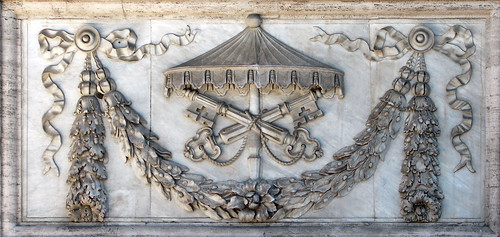
In this time of the interregnum, all are requested to participate in this novena for the election of the Sovereign Pontiff: Here is a link to a pdf with the prayers in Latin and English.
Sunday, February 24, 2013
Third Sunday in Lent
For March 3, 2013 which is the Third Sunday in Lent, we are going to sing:
- Procession: Blessed Lamb
- Asperges me
- Introit: Oculi mei
- Kyrie XVII A
- Gradual: Exsurge Domine
- Tract: Ad te levavi
- Credo III
- Offertory: Iustitiae Domini
- Offertory hymn: Jesu, Salvator Mundi (B. Cordans)
- Sanctus XVII
- Agnus Dei XVII
- Communion: Passer invenit with Psalm 83:4-5
- Recession: Alas! And Did My Saviour Bleed (tune: Martyrdom)
Monday, February 18, 2013
Second Sunday in Lent
For February 24, 2013 which is the Second Sunday in Lent, we are going to sing:
- Procession: The Son Of Man (tune: Newman)
- Asperges me
- Introit: Reminiscere
- Kyrie XVII A
- Gradual: Tribulationes cordis mei
- Tract: Confitemini Domino
- Credo I
- Offertory: Meditabor
- Offertory hymn: Audi Benigne Conditor
- Sanctus XVII
- Agnus Dei XVII
- Communion: Intellige clamorem with Psalm 5:2-4
- Recession: God of Mercy And Compassion
Friday, February 15, 2013
On veneration of ancestors


.JPG)
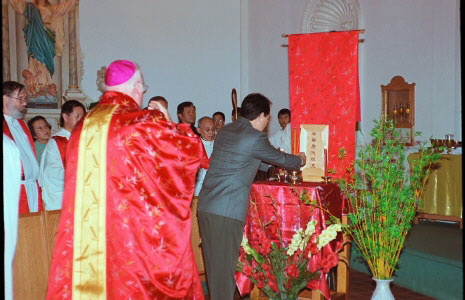
Since it is Chinese New Year again, the topic of ancestral veneration done in certain Novus Ordo churches crops up again and here are some thoughts from yours truly and the response from Rev. Fr. Daniel Couture and Rev. Fr. Francois Lainey on this matter.
This is mostly in response to the articles written by Rev. Fr. Michael Cheah (of the Penang Diocese) part1, part2 and Deacon Sherman Kuek (Melaka-Johor Diocese)
Many Catholics in Malaysia of ethnic Chinese-descent are
converts. I do not agree if it is done during Holy Mass. Even Fr.
Michael Cheah concedes that it is to be considered as a 'para-liturgy',
but you can't force everyone to take part in it if it is a
'para-liturgy'.
As a Chinese, we must also bear in mind the common pagan/superstitious belief that the spirit of the dead ancestor resides in the tablet (http://en.wikipedia.org/wiki/
I still cannot find a valid reason why is there a need to do it in
church, more so since it is also causing scandal among Catholics
(Chinese and non-Chinese alike). We can visit the graves to clean it,
but I don't see a need to offer joss-sticks, food, tea/wine, paper
money, etc.
Some Catholics might not have those pagan/superstitious ideas when
they perform the rites, but certainly it can't be said for all
Catholics. Thus, I think Deacon Sherman Kuek's article is considered the
moderate approach to this controversy.
"In other words, our way of evangelization should not make it more
difficult than necessary for people to accept the Gospel. In the days of
ancient China, to insist on terminating veneration rites actually
scandalized the populace and prevented them from accepting the Gospel.
This cannot be said of most disapora Chinese today. It is reasonable
to hold that neither forbidding nor permitting veneration of ancestral
tablets would gravely affect the success of the Church’s mission to
evangelize the Chinese community in a place like Malaysia.
If anything, non-Christians probably find it strange that Catholics
would do such a thing in the course of performing our liturgical rites.
It is perhaps wise to ask ourselves if such a practice truly serves its
evangelistic purpose or if we do it just because we can."
----------------------------------------------------------------------------------------------------------
Response by Rev. Fr. Daniel Couture:
In all these matters, one has to remember some essential doctrinal issues:
1) At death the soul is separated from the body, is judged, and goes to heaven, purgatory or hell (we speak here of those who have reached the age of reasons “ancestors”)
2) We can only know for sure the state of a deceased soul in the case of a canonisation, when the Church, and only the Catholic Church, tells us that that soul IS in Heaven, and we can pray TO it. For all the other souls, we can only pray FOR them (although the saints do say that we can also pray TO the souls in Purgatory). (I do not enter here in the questionable modern canonisations.)
3) Reincarnation – in another person, an animal or a tablet – is absolutely false, both philosophically and theologically.
4) Souls separated from their body do not eat.
5) We can certainly honor the memory of our ancestors, honor their photo, out of filial piety, but it must have nothing that includes or implies their presence in a thing, their power of intercession, their material needs.
------------------------------------------------------------------------------------------------------------
Response by Rev. Fr. Francois Laisney:
Father Couture has given all good principles on the matter. There is one additional consideration that I would add: to distinguish between natural and supernatural veneration. But first of all, let us explain what is veneration.
To venerate, to honour, means to give a testimony to the excellence of someone, as St Thomas teaches. Now there are four kinds of excellence on earth that is given special honour:
1) excellence of knowledge: e.g. Nobel prices for scientists, titles (such as university titles: Doctor …), and even prizes in school (e.g. first prize of English, of science, of math, of history…)
2) excellence in virtue: e.g. military medals to reward the courage of some soldiers, even Olympic medals (for bodily virtue…)
3) excellence in authority: presenting arms when a general reviews his army, or titles given to people in authority (your lordship,…). This is given to government authorities, to judges, …
4) the special excellence of parents, which St Thomas explains is the excellence of being at the ORIGIN of what the children have: they received their life from their parents, and a very great many other things. If we would reckon how much we owe our parents, we would easily understand that we can hardly repay them enough. To honour them is to acknowledge this excellence that THEY have over us. Note that benefactors – in a much lesser way – also participate of that kind of excellence, and honour is due to them for that reason.
Now every one can easily see that in all these four domains, God possesses the supreme excellence:
1) He knows absolutely everything, not only which has existed, exist and will exist, but also all that could have existed if He had so created them… and above all the created things, He knows Himself comprehensively.
2) He possesses the supreme virtue, i.e. goodness in all His actions, His being is pure Act, pure Goodness. Thus He always acts with supreme wisdom, supreme goodness, fortitude, kindness, mercy, etc.
3) God possesses supreme authority, and all authority come from Him (Rom. 13:1)
4) God is at the origin of all created beings, of all good.
And in this matter of excellence, there is an essential difference between God’s excellence, which He possesses by Himself, not having received it from anyone, and any creature’s excellence, which is only relative: it always came ultimately from God, Who is the First Cause of all good and therefore of all excellence. God alone can be the FIRST in any of the above domains. He also is the source of life; parents only transmit life; He alone is the source of goodness; anyone else can only transmit goodness…
Therefore there is due to God a unique veneration, called Worship. It is a very grave sin to worship anyone else than God.
So now we come to my point. There are two levels of excellence: natural excellence and supernatural excellence. All the examples above were of natural excellence. But God also offers to men a supernatural excellence: sanctifying grace, a participation in the divine life. Not all men accept it and live it. It is received at baptism, is lost by mortal sin, is recovered by penance, grows through the Sacraments and prayer and the practice of good works, etc.
One can find also supernatural excellences of the four kinds expressed above:
1) the Doctors of the Church had an excellent knowledge of Revelation, of the Doctrine of Christ, and they receive for that reason a special honour: the title of Doctor of the Church.
2) Saints excelled in supernatural virtue, and receive the veneration of “dulia”.
3) those in authority in the Church: Pope, bishops, priests receive for that reason special honours.
4) Those priests and others who have given us the supernatural life in Baptism, the supreme Food in the Holy Eucharist, and many other supernatural benefits ought also to be honoured for that reason too.
Now the business of the Church is above all to give worship to God and in a lesser degree to give that supernatural honour to those who deserve it, i.e. to the Saints. It is also the business of the Church to pray for our departed relatives.
It is NOT the business of the Church to give NATURAL veneration to those who – even truly – deserve it: the Church does not confer Nobel prizes, Olympic medals, etc. Hence it seems to me that it is not befitting to have in the church the veneration of ancestors – which, when done without superstition, is perfectly legitimate, acknowledging all the good natural things one has received from them, as explained above. That natural veneration may well be done at home, when it is without superstition.
In order to clearly distinguish between the natural veneration of ancestors and the supernatural worship to God and (lesser) honour to the Saints, it is particularly important not to mix things up: venerating the ancestors in the church brings the danger to forget that essential difference. Thus it is not only out of place, it is also dangerously misleading.
It should be noted that when Pius XII permitted the veneration of ancestors, it was NOT in the churches, but only as a natural honour as explained above. To bring it into the churches is the wrong inculturation of Vatican II.
It seems to me that this settles the matter. What do you think?
Tuesday, February 12, 2013
Domine, non secundum peccata nostra
This is the hauntingly beautiful Tract from the Ash Wednesday liturgy
Monday, February 11, 2013
First Sunday in Lent
For February 17, 2013 which is the First Sunday in Lent, we are going to sing:
- Procession: The Glory of These Forty Days
- Asperges me
- Introit: Invocabit me
- Kyrie XVII A
- Gradual: Angelis suis
- Tract: Qui habitat
- Credo IV
- Offertory: Scapulis suis
- Offertory hymn: Attende Domine
- Sanctus XVII
- Agnus Dei XVII
- Communion: Scapulis suis with Psalm 90:4-5
- Recession: O Sacred Head Surrounded
Monday, February 04, 2013
Quinquagesima Sunday
For Feb 10, 2013 which is Quinquagesima Sunday, we are going to sing:
- Procession: O God Almighty Father
- Asperges me
- Introit: Esto mihi
- Kyrie XI (Orbis factor)
- Gradual: Tu es Deus
- Tract: Iubilate Domino omnis terra
- Credo III
- Offertory: Benedictus es... in labiis meis
- Offertory hymn: Ave Maria (J. Arcadelt)
- Sanctus XI
- Agnus Dei XI
- Communion: Manducaverunt et saturati with Psalm 77:29, 30
- Recession: Soul Of My Savior

Monday, January 28, 2013
Sexagesima Sunday
For February 3, 2013 which is Sexagesima Sunday, we are going to sing:
- Procession: O God Almighty Father
- Asperges me
- Introit: Exsurge, quare obdormis
- Kyrie XI (Orbis factor)
- Gradual: Sciant gentes
- Tract: Commovisti
- Credo III
- Offertory: Perfice gressus meos
- Offertory hymn: Ave Maria (J. Arcadelt)
- Sanctus XI
- Agnus Dei XI
- Communion: Introibo ad altare Dei with Psalm 42:4
- Recession: Soul Of My Savior
Tuesday, January 22, 2013
Septuagesima Sunday
For Jan 27, 2013 which is Septuagesima Sunday, we are going to sing:
- Procession: All Hail, Adored Trinity
- Asperges me
- Introit: Circumdederunt me
- Kyrie XI (Orbis factor)
- Gradual: Adiutor in opportunitatibus
- Tract: De profundis
- Credo I
- Offertory: Bonum est confiteri
- Offertory hymn: O Maria, Virgo Pia
- Sanctus XI
- Agnus Dei XI
- Communion hymn: O quam amabilis (G.P. da Palestrina)
- Communion: Illumina faciem tuam
- Recession: Hail, Holy Queen Enthroned Above
Wednesday, January 16, 2013
Second Sunday after Epiphany
- Procession: Let All Mortal Flesh Keep Silence
- Asperges me
- Introit: Omnis terra
- Kyrie VIII (De Angelis)
- Gloria VIII
- Gradual: Misit Dominus
- Alleluia: Laudate Deum
- Credo IV
- Offertory: Jubilate Deo, universa terra
- Offertory hymn: Cor Jesu, Caritatis Victima
- Sanctus VIII
- Agnus Dei VIII
- Communion hymn: Flos De Radice Jesse
- Communion: Dicit Dominus: Implete hydrias
- Recession: What Star Is This
Monday, January 07, 2013
The Holy Family
- Procession: O God Of Loveliness
- Asperges me
- Introit: Exsultet gaudio
- Kyrie IV (Cunctipotens genitor Deus)
- Gloria IV
- Gradual: Unam petii
- Alleluia: Vere tu es Rex
- Credo III
- Offertory: Tulerunt Iesum parentes
- Offertory hymn: Adeste Fideles
- Sanctus IV
- Agnus Dei IV
- Communion hymn: Iesu, Dulcis Memoria
- Communion: Descendit Iesus cum eis
- Recession: O Little Town Of Bethlehem (tune: Forest Green)
Subscribe to:
Posts (Atom)